Iraq's Jaafari code turns citizenship into sect, and women are the test case



Shafaq News
Consider two Iraqi children, both aged seven, both living with their mothers after a divorce. Under the civil law that has governed Iraqi families since 1959, the first stays with his mother until he is fifteen, when he may choose for himself before a judge. Under the Jaafari Personal Status Code, approved by parliament last August, the second passes to his father now, automatically, with no requirement that anyone demonstrate his mother has failed him. The two children hold the same citizenship. The difference between them is which legal track their parents entered, and in a growing number of cases, which track one parent entered without telling the other.
Iraq did not repeal its civil family law. Personal Status Law No. 188 of 1959 remains in force. What changed is that an amendment passed in February 2025 allowed couples registering a marriage to choose whether their marriage, divorce, custody, and inheritance would be governed by that law or by the jurisprudence of the Jaafari school, the legal tradition of Twelver Shiite Islam, known also as Imami jurisprudence after the twelve Imams whose rulings supply its authority. Shiite religious authorities then drafted the Code, more than 300 articles, to give the choice content. Parliament approved it on August 27, 2025. The 1959 law survives, but without governing all Iraqis.
Read more: New Jaafari Code fuels deep division in Iraq
Human Rights Watch called for immediate repeal on October 15, describing the amendment as unlawful and unconstitutional. Sarah Sanbar, the organization's Iraq researcher, said the Code "further institutionalizes discrimination against women, legally relegating them to second-class citizens."
The provisions the organization singled out concern control as much as content. A husband may convert the marriage contract to Jaafari governance without his wife's consent or knowledge. He may divorce her without informing her. Care of children passes to the father once they turn seven, whatever a court might otherwise conclude about their interests. A wife may write a clause into her contract barring polygamy or unilateral divorce, but should her husband disregard it, the second marriage or the divorce stands regardless.
Retroactivity is where those provisions have begun reaching into settled lives. Human Rights Watch documented the case of a woman it identified as Ghazal H., who divorced a violent husband in 2015 under the 1959 law, after a court had convicted him of assault. On September 11, 2025, she received a summons. Her former husband had filed to apply the Jaafari Code retroactively to their decade-old marriage contract and to terminate her guardianship of their ten-year-old son. She had not been consulted or informed. "It is unacceptable that someone marries under a law that protects the rights of women and children, and then, more than a decade later, manipulates the law to strip those rights away," she said.
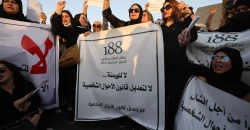
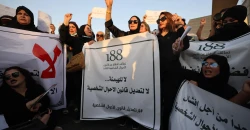
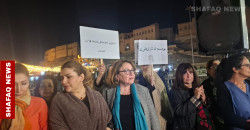
That is the grievance Iraqi women's organizations have taken to the street. In Baghdad, dozens of women demanded that the amendments not be applied backward to marriage contracts concluded before they took effect, and that the custody provisions and the implementing decision governing them be reopened. Their placards called for the interest of the child to be the operative standard in custody rulings.
Lena Ali, an Iraqi broadcaster and civil activist known for her advocacy on women's and children's issues, told Shafaq News that the Code has not produced what was promised on its behalf. It "did not achieve its declared goal of reducing divorce rates or improving the condition of the family," she said, and has instead brought "an increase in domestic violence and greater complication in disputes between spouses after divorce." On custody, she was unsparing. "Removing children from their mothers in this way crushes the natural relationship between a mother and her child, and leaves deep psychological effects on children," she said, calling the Code "unjust" and arguing that it "does not represent religious law fairly." Some of its provisions, she added, "are being used to pressure women and influence them in divorce and custody cases."
The case for the amendment is not made only by clerics, and its strongest version turns Ali's argument on its head. Mohammed Jassim al-Khafaji, a member of the parliamentary legal committee, has argued publicly that Article 57 of the 1959 law, the provision granting mothers custody to fifteen, had itself become an instrument of coercion. The article makes custody a near-absolute maternal right, he wrote, and applies not only after divorce but during a subsisting marriage, so that an ordinary marital quarrel can be escalated by a mother, assisted by those who make a living from such disputes, into a case where the child becomes a weapon against the father, and the dispute is driven toward separation. A father who tries to keep his own children, he wrote, may find himself facing an abduction complaint.
Al-Khafaji's account is contested, and his language is combative. It is also the argument the Code's supporters actually make, and it identifies something the Code's critics tend to pass over: the civil law's custody regime was not neutral either, and the campaign to displace it drew energy from fathers who experienced it as an instrument used against them.
Read more: Iraq’s Controversial Personal Status Law
Sheikh Mohammed Khalil al-Sinjari, a representative of the Shiite religious authority in Baghdad, put the doctrinal case to Shafaq News in gentler terms. "The mother has the greater right to custody in the early years, but there are legal conditions that may prevent that from continuing in some cases," he said. Imami jurisprudence "takes the child's interest as its primary consideration and may grant custody to the mother or the father according to circumstances."
Impediments touching conduct or upbringing may move a child from one parent to the other, he said, "but the principle is regard for the child's interest, not conflict between the parents."
Both defenses share a premise, that a custody rule should be judged by whether it serves children. What neither addresses is that Iraq now has two such rules, that they produce opposite outcomes for children of identical ages, that a Shiite parent may in some circumstances move a family from one to the other without the other parent's knowledge, and that the transfer can reach backward to contracts signed years before either rule existed in its current form.
Walid Mohammed al-Shubaibi, a lawyer, traced the trouble to Iraq's legislative record rather than to its clerics. Protest is a constitutional right, he told Shafaq News, but "the evaluation of laws should not be subject to emotion or agitation." Law 188 has been amended so often, in his reading, that its internal balance has broken down, Article 57 above all, producing "a distortion of justice between the parties, not only against women but against their family networks as well."
Amendments introduced under exceptional conditions have outlived the conditions that justified them, he said, and their continued operation "calls for serious legal review." The remedy lies neither in hardening positions nor in fracturing into camps, he argued, but in restoring balance to the text.
He does not draw the implication, but it follows. A civil code hollowed by six decades of amendment, and defended by few, was poorly placed to resist a parallel jurisdiction grafted onto it.
Iraq's post-2003 settlement rested on a premise that political power could be apportioned by sect while the law remained common to all citizens. The Jaafari Code puts that premise to the test, and the early results are legible without any legal training. A Sunni woman and a Shiite woman, holding the same passport and living under the same constitution, may now inherit, be divorced, and keep or lose their children on different terms.
The women demonstrating in Baghdad are asking something narrower than whether Iraq should be governed by religious law, and harder to dismiss. They are asking whether an Iraqi's legal status can be rewritten, years after the fact, by someone else.
Read more: Iraq's Women: Fighting for rights in a patriarchal stronghold
Written and edited by Shafaq News staff.