Last projectionist: Kirkuk collector preserves Iraq’s fading cinema era


Shafaq News- Kirkuk
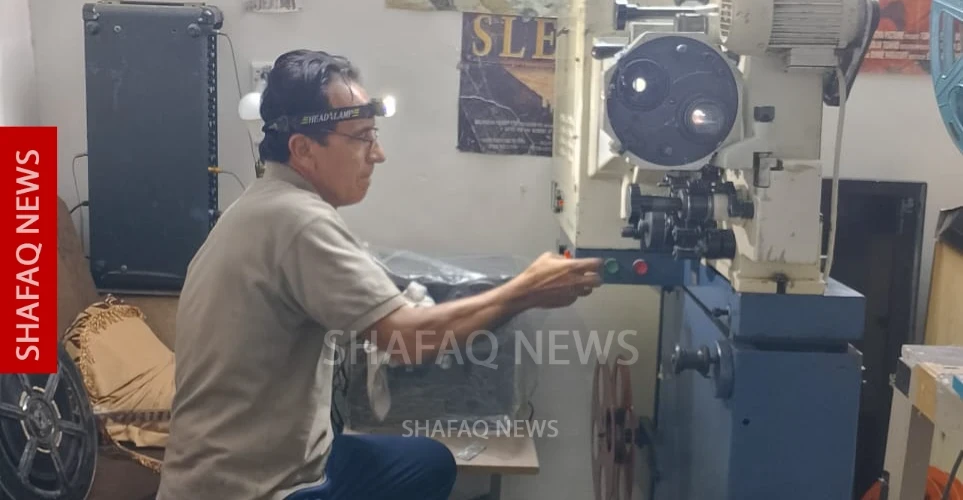
Inside a small shop tucked into one of Kirkuk’s old markets, Delir al-Jaf sits surrounded by towering film projectors, metal reels, and stacks of aging movie tapes, preserving fragments of an Iraqi cinema culture that has largely disappeared beneath the rise of smartphones, streaming platforms, and modern screens.
The narrow space resembles less a store than a private museum of Iraq’s cinematic past. Arabic, Turkish, and foreign films line the shelves beside three massive projectors that still function decades after they once illuminated crowded movie theaters across Kirkuk.
The smell of aging film rolls mixes with the sound of metal reels turning in a place where nearly every object carries the memory of a vanished era.
Born in the 1970s, al-Jaf says his connection to cinema began as a child, when Kirkuk’s theaters were still packed with families and young audiences.
He still remembers entering al-Khayyam Cinema in 1979 to watch a foreign film amid heavy crowds. Yet what captured his attention most was not the movie itself, but the projection machine at the back of the hall.
“I kept watching the beam of light coming from the lens toward the giant screen,” he told Shafaq News. “That curiosity later became an obsession.”
What followed was decades spent collecting and restoring old cinema projectors once used across Iraqi theaters.
His first purchase was a 16mm “Olmo” projector bought in Kirkuk market for 52 dinars, a machine commonly used in schools and small halls to screen documentaries and short films.
Years later, he acquired a rare Russian-made 35mm projector for 152 dinars, explaining that such machines were designed for feature-length films shown in major cinemas and were considered rare equipment in Kirkuk at the time.
Al-Jaf said Iraq’s old theaters primarily relied on Italian, British, and Russian projectors, including well-known brands such as “Cinemeccanica” and “Victoria,” with 35mm film serving as the dominant commercial cinema format worldwide.
Unlike modern digital projection, the older systems depended entirely on mechanical reels, powerful lamps, and manually threaded film strips passing through lenses before reaching the screen.
Despite their age, all three projectors in his collection still operate today. He continues maintaining their lenses and mechanical components regularly, describing them not as obsolete devices but as part of Iraq’s artistic memory.
For al-Jaf, cinema once represented far more than entertainment.
He recalls a period when movie theaters functioned as social and cultural centers where audiences gathered before screenings and nearby cafés filled with conversations about actors, films, and new releases. Kirkuk itself once hosted between five and seven major cinemas, including al-Khayyam, Atlas, Salah al-Din, and al-Muallimeen cinemas, making the city one of Iraq’s most active cultural centers during the peak of theatrical film culture.
Arabic, Turkish, Indian, and international films attracted large audiences, particularly during holidays, when long ticket lines stretched outside theater entrances for hours.
Writer Mohammed Khudr says Kirkuk’s cinemas played a major role in shaping the city’s cultural consciousness across generations. “The city’s ethnic and cultural diversity was reflected in the films shown there,” he told Shafaq News. According to Khudr, Iraq’s cinema decline accelerated gradually during years of war and sanctions before most theaters disappeared entirely after 2003 due to neglect, weak institutional support, and the spread of newer viewing technologies.
Researcher Abdul Karim Khalifa described al-Jaf’s collection as an important archive of the city’s cultural memory.
“These machines carry historical and artistic value,” he said, adding that younger generations may no longer fully grasp the influence cinemas once had on Iraqi social life.