The long shadow of Sinjar: Twelve years after the ISIS genocide


Shafaq News
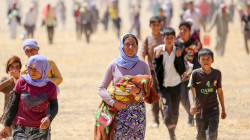
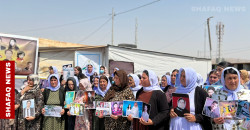
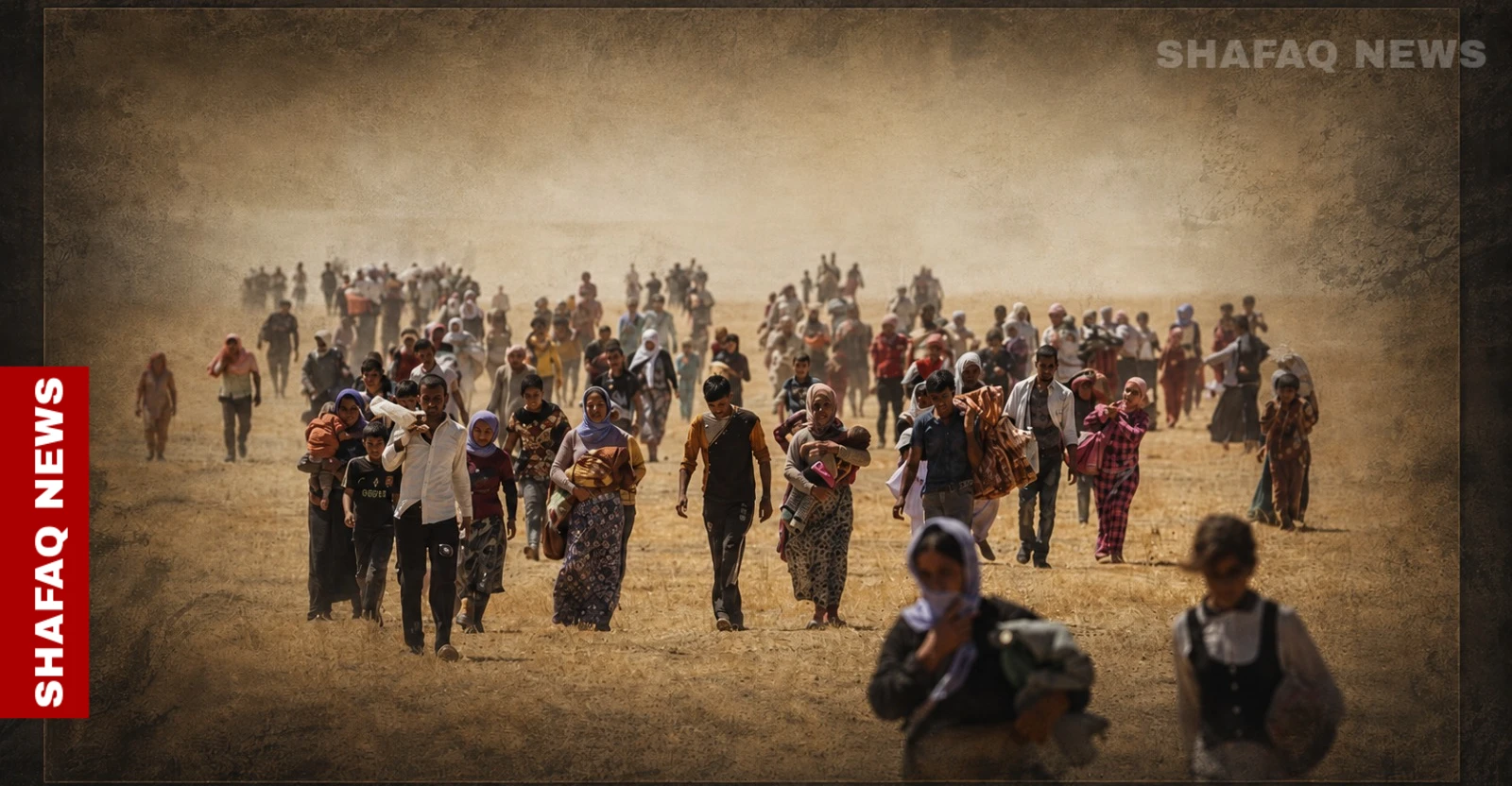
In 2014, ISIS launched its assault on Nineveh’s Sinjar district; the consequences of one of the group's gravest crimes continue to define the lives of thousands of Yazidis. Every August 3, the community commemorates a genocide that claimed countless lives, uprooted entire families, and left thousands searching for missing relatives, while many remain unable to return to a homeland still struggling to recover.
According to the Kurdistan Region's Office for Kidnapped Affairs, nearly 2,500 Yazidis remain missing, while more than 200,000 are still displaced.
Speaking to Shafaq News, Hussein al-Qaidi, director of the Office for Kidnapped Affairs, revealed that ISIS abducted 6,417 Yazidis during the attack on Sinjar. Since then, 3,595 captives have been rescued, with operations continuing despite increasingly complex conditions, he explained, citing the movement of ISIS families between camps and towns in northeastern Syria, shifting security dynamics, and the repeated relocation of captives over the years. The office, established under the direction of Kurdistan Region President Nechirvan Barzani, continues pursuing every credible lead to determine the fate of those still unaccounted for.
A Campaign to Destroy a Community
The assault on Sinjar, a disputed territory under Article 140 of the Iraqi Constitution claimed by both the Iraqi government and the Kurdistan Regional Government, extended far beyond the capture of territory. It formed part of a systematic campaign targeting the Yazidis because of their religious identity.
The Yazidis, an ethno-religious community whose members are predominantly Kurdish-speaking, follow an ancient monotheistic faith centered on the holy temple of Lalish. For generations, misconceptions portraying them as "devil worshippers" fueled discrimination against the community. ISIS exploited those narratives to justify persecution, portraying Yazidis as a group that could be eliminated or forcibly converted.
As the militants advanced, they imposed a calculated system of persecution. According to the United Nations, men and older boys were often forced to choose between conversion to Islam and execution. Women and girls were abducted, subjected to systematic sexual violence, and repeatedly sold across ISIS-held territory. Young boys were separated from their families, stripped of their identities, and indoctrinated for military service.
The UN Investigative Team to Promote Accountability for Crimes Committed by Da'esh/ISIL (UNITAD) later concluded that these crimes were neither isolated nor spontaneous. Its investigations found that ISIS deliberately targeted Yazidi civilians through coordinated killings, forced displacement, enslavement, family separation, and the organized transfer of captives as part of a campaign to destroy the Yazidi community “physically and biologically.”
The Fall of Sinjar
By the time ISIS reached Sinjar, it had already seized Mosul, Tal Afar, Rabia, al-Baaj, and al-Qayrawan, steadily expanding its control across northwestern Iraq. On August 1, 2014, the group overran Iraqi Army and Kurdish Peshmerga positions in Zummar, capturing weapons, ammunition, and military equipment before severing the main road linking Sinjar to the Kurdistan Region and leaving the district largely isolated.
Shortly after midnight on August 3, ISIS launched coordinated attacks on the residential complexes of Ger Zarik and Siba Sheikh Khidir before advancing toward Tal Banat and Tal Qasab. By around 7:00 a.m., shelling had reached central Sinjar, where residents armed with little more than light weapons attempted to defend their towns. The local defenses quickly collapsed. In Kocho, the force assigned to protect the village withdrew at approximately 6:30 a.m., leaving residents without protection. By midday, most of Sinjar had fallen under ISIS control, forcing tens of thousands of civilians to flee.
Many escaped toward Mount Sinjar, where they became trapped without adequate food, water, or medical care after ISIS surrounded the area. US-led Coalition aircraft later dropped emergency humanitarian aid, but the supplies proved insufficient for the vast number of civilians stranded on the mountain. Around August 8, a humanitarian corridor through northeastern Syria enabled thousands to reach safety in the Kurdistan Region. Many others, however, never escaped.
Among the dozens of villages devastated during the assault, Kocho became the defining symbol of the genocide. After nearly two weeks under siege, ISIS ordered residents to gather at the village's secondary school on August 15, 2014, where fighters separated men and older boys from women and children.
Hundreds of men and teenage boys were taken to nearby fields and executed before being buried in mass graves, while women and girls were transferred into a system of captivity, sexual slavery, and forced marriage. According to UNITAD, at least 422 residents of Kocho were killed, while subsequent investigations uncovered mass graves, including those at Solagh and the Mothers' Grave, where older Yazidi women, considered by ISIS to be unfit for sale or enslavement, were executed.
Read more: Iraq's mass graves: A record of violence across five decades
Life Before And After Captivity
For many Yazidi families, the defeat of ISIS brought relief but not closure. The search for those who disappeared during the genocide remains one of the community's greatest challenges.
Thousands who escaped captivity face a different battle. Women who survived years of enslavement continue to require psychological, legal, and social support, while children rescued after prolonged captivity often struggle to reconnect with their families after being stripped of their identities under ISIS rule. Iraqi and Kurdistan Region authorities, together with international organizations, have expanded rehabilitation programs, while Germany —particularly the state of Baden-Württemberg— has received hundreds of Yazidi women and children for specialized medical and psychological treatment.
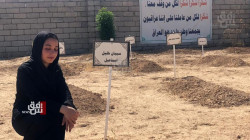
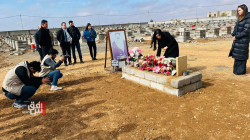
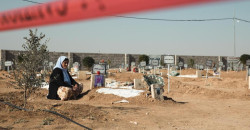
The search for answers increasingly extends to the mass graves scattered across Sinjar and neighboring areas.
More than 80 mass graves have been documented, with forensic teams recovering the remains of 776 victims. So far, 297 victims have been identified and returned to their families, while 479 remain unidentified pending DNA analysis. The identification process remains lengthy and technically demanding, relying on genetic samples from relatives and detailed forensic examinations before victims can finally be laid to rest.
Read more: A Decade later, trauma drives the mass migration of Iraq's Yazidis
Rebuilding Sinjar And The Pursuit of Justice
Recovering victims is only one part of Sinjar's long recovery.
Despite ISIS' military defeat, many Yazidis remain unable to return because of damaged infrastructure, limited public services, economic hardship, and continuing security concerns. Political and administrative disputes, coupled with the presence of multiple security actors, have further slowed reconstruction and the restoration of normal governance.
In 2020, Baghdad and the Kurdistan Regional Government signed the Sinjar Agreement, with United Nations support, to normalize security arrangements, restore local administration, and facilitate the return of displaced residents. Although implementation has progressed slowly, Iraqi authorities took another step in 2025 by issuing official property ownership documents to residents whose records had been lost or destroyed during the conflict, helping resolve ownership disputes and support reconstruction. Many Yazidis, however, argue that rebuilding requires not only homes and property rights, but also security, healthcare, education, employment opportunities, and functioning public institutions.
Efforts to achieve justice have advanced alongside reconstruction, though many survivors believe accountability remains incomplete.
Iraq adopted the Yazidi Female Survivors Law in 2021, providing compensation, healthcare, education, housing, employment opportunities, and rehabilitation services. According to official figures, 2,216 survivors have benefited from the law, although many families continue to await answers about missing relatives and the full implementation of its provisions.
Read more: Yazidis struggle to return home a decade after ISIS atrocities: report
While Iraqi courts have prosecuted hundreds of ISIS members under anti-terrorism legislation, human rights organizations have repeatedly called for prosecutions that reflect the full scale of the crimes committed against the Yazidis, including genocide and crimes against humanity. Internationally, Germany and France have formally recognized the Yazidi genocide, while German courts have issued landmark convictions against former ISIS members on genocide charges. UNITAD likewise concluded that ISIS committed genocide against the Yazidis, documenting extensive forensic, testimonial, and documentary evidence during its investigations in Iraq.
For the Yazidi community, the legacy of August 3, 2014, extends far beyond the anniversary itself. It endures in the search for the missing, the pursuit of justice, and the determination to rebuild a community whose future continues to be shaped by one of the most devastating atrocities committed by ISIS in Iraq.
Written and edited by Shafaq News staff.