Salinity and drought ravage Iraq’s historic farmlands


Shafaq News
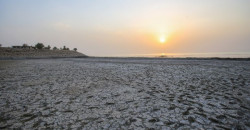
Nearly 78% of Iraq’s territory is either already desertified or vulnerable to further land degradation, according to official Iraqi and United Nations data, threatening farmland, rural livelihoods and food security as rising salinity and shrinking water resources reshape one of the Middle East’s oldest agricultural landscapes.
The crisis has moved beyond Iraq’s desert regions, reaching fertile areas once sustained by the Tigris and Euphrates rivers. Productive fields are disappearing, vegetation cover is declining, and communities dependent on farming, fishing and livestock are facing growing uncertainty as environmental pressures intensify.
In 2025, the World Bank identified Iraq as among the countries most vulnerable to climate change, warning that rising temperatures, lower rainfall and worsening water shortages are placing additional pressure on agriculture, ecosystems and economic development.
The Iraq Green Observatory, an Iraqi-based environmental monitoring group, describes desertification and land degradation as among the country’s most serious environmental and economic challenges. “Desertification has struck Iraq hard over the past two decades, and the latest official data and environmental reports available through June 2026 indicate that the scale of the problem continues to expand," Observatory member Omar Abdul Latif told Shafaq News.
Around 55% of Iraq’s territory has already become desertified, while another 23.2% remains vulnerable to further degradation, according to Abdul Latif. Together, the figures mean that nearly four-fifths of the country is either already affected or at risk of losing productive capacity unless action is taken to slow the deterioration.
The impact is particularly severe in agriculture, where decades of land degradation, overgrazing and declining water resources have steadily reduced Iraq’s productive capacity.
Abdul Latif estimated that Iraq has lost between 15% and 30% of its agricultural land over the past three decades because of worsening environmental conditions.
For many rural households, the losses threaten a major source of income. Agriculture remains central to communities that depend on crop production, livestock, and related activities, according to assessments by the Food and Agriculture Organization (FAO).
‘’The damage has been especially severe in irrigated farmland. Around 71% of Iraq’s irrigated land has been affected by desertification, a considerably higher share than in neighboring Turkiye and Syria,’’ Abdul Latif noted.
What was once largely associated with Iraq’s arid regions has spread into the Mesopotamian alluvial plain, an area historically known for fertile soil and agricultural production along the Tigris and Euphrates rivers.
Rising salinity has emerged as another major threat to cultivation. Abdul Latif revealed that about 61% of Iraq’s agricultural land is now vulnerable to salt accumulation, while the country loses roughly 100,000 dunams (25,000 hectares) of productive land each year because of worsening soil conditions.
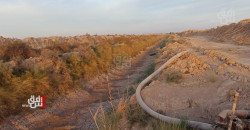
The buildup of salt has been linked to continued reliance on traditional flood irrigation, weak drainage networks and rising saline groundwater, which have accelerated soil degradation across agricultural areas.
Read more: Death in the current: Pollution decimates Iraq’s river ecosystems
Rivers Run Dry
Behind the loss of productive farmland lies a deeper water crisis affecting both the availability and quality of Iraq’s freshwater resources.
The country relies heavily on the Tigris and Euphrates rivers for its water supply, leaving it highly vulnerable to reduced river flows, changing rainfall patterns and rising temperatures. Assessments by the World Bank and FAO have warned that declining water availability is already affecting agriculture, ecosystems and rural communities.
The challenge is not only the amount of water reaching Iraq’s fields. The quality of that water is also deteriorating. Agricultural drainage has placed additional pressure on the country’s waterways, with large quantities of saline water returning to the same river systems that support farming and ecosystems.
"The country's waterways are facing additional strain from agricultural drainage," Abdul Latif remarked, pointing out that Iraq releases around 23 billion cubic meters of saline drainage water into its rivers each year.
The discharge has increased salinity levels in the Tigris, Euphrates, and Shatt al-Arab waterways, affecting agricultural production and placing additional pressure on fisheries.
Read more: The cost of filth: Iraq among the world’s most polluted nations
Environmental decline has also become increasingly visible in Iraq’s cities, where disappearing vegetation has weakened natural barriers against heat and dust.
Half of Iraq’s forests and green belts have disappeared over recent decades, removing ecosystems that once helped reduce dust storms and slow the spread of dry conditions. Baghdad offers one of the clearest examples of this transformation. Much of the capital’s green belt has vanished, while dusty days have increased sharply.
The city now experiences around 272 dusty days each year, compared with roughly 24 annually in the 1970s, according to the Iraq Green Observatory.
"The increase in dust storms has become one of the most visible signs of Iraq's changing environment, affecting transportation, public health and daily life across the country," it added, noting that with fewer trees and green spaces available to absorb heat and trap dust particles, urban areas have become more exposed to higher temperatures, poorer air quality and the broader consequences of changing weather patterns.
The consequences are also reshaping life in Iraq’s rural communities, particularly in the Mesopotamian Marshes, which were recognized as a UNESCO World Heritage Site in 2016 for their ecological and cultural importance.
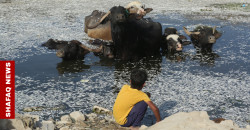
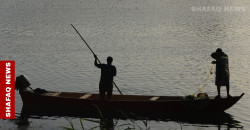
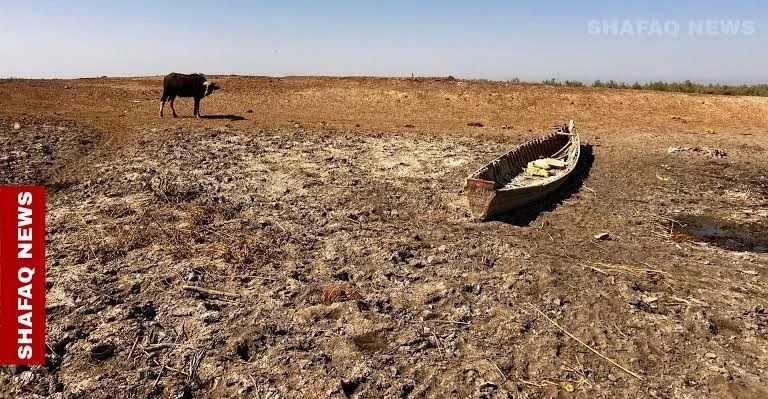
According to the Iraq Green Observatory, thousands of villages have lost income from farming, fishing and water buffalo breeding as ecosystems have deteriorated. Lower water levels in the Tigris and Euphrates, together with reduced water releases, have dried up large parts of the marshes in recent years, contributing to livestock losses, declining fish stocks and the migration of many rural families to urban areas.
Although improved water availability in parts of the marshes during 2026 helped restore some ecosystems, the recovery remains fragile without stable water allocations and long-term management of the country’s water resources.
Read more: The air we breathe: How pollution is quietly rewriting Iraq’s future
The World Bank has also warned that climate-related pressures have forced thousands of farmers to reduce planting or abandon their fields as fuel, fertilizer and seed costs rise and imported products become more competitive.
Addressing the crisis, it added, will require sustained efforts combining modern water management, rehabilitation of degraded land, expanded tree-planting initiatives, restoration of green areas, and improvements to irrigation and drainage systems.
"Desertification is no longer solely an environmental issue. It has become a matter of food, water and social security," Abdul Latif concluded, warning that continued losses of productive land will leave Iraq facing greater challenges in the years ahead.
Read more: Death in the current: Pollution decimates Iraq’s river ecosystems
Written and edited by Shafaq News staff.