Iraq under regional pressure as neighbors threaten to strike Iran-aligned factions


Shafaq News
Iraq is facing a fresh wave of regional pressure after Saudi Arabia struck sites inside the country and several neighboring states, including Kuwait, Jordan and Syria, warned Baghdad that any attack launched from Iraqi soil against their territory would be met with direct military retaliation against armed factions inside the country.
The warnings, conveyed through diplomatic channels in recent days, reflect growing alarm that Iraq is being pulled more into confrontation between the United States and Iran and its regional allies.
This pressure follows a string of drone and rocket attacks attributed to Iran-aligned Iraqi armed factions, targeting interests and installations in neighboring states, chiefly Saudi Arabia. It has prompted regional calls on Baghdad to prevent Iraqi territory from being used to threaten the wider region's security.
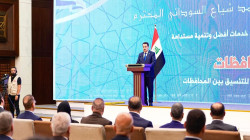
In response, the Iraqi government has insisted it will not allow its territory to be used to attack neighboring states. Prime Minister and Commander-in-Chief of the Armed Forces Ali al-Zaidi, chairing an emergency security meeting on Saturday evening, stressed the need to prevent any breach or threat originating from Iraq, and ordered the formation of a joint security committee along with deterrent mechanisms to prevent further violations.
Al-Zaidi also directed security and military agencies to raise their level of readiness and strengthen intelligence and defensive measures, affirming that protecting Iraqi sovereignty and preventing the country from becoming an arena for settling regional scores is the exclusive responsibility of official state institutions.
Read more: Wednesday's US-Saudi attack on Iraq: What Is Known
Regional Pressure Mounts
Saudi Arabia announced in recent days that it had intercepted drones it said were launched from Iraqi airspace toward vital installations inside the kingdom, and responded, in coordination with US Central Command (CENTCOM), by striking sites and depots affiliated with the Popular Mobilization Forces (PMF) —the state-affiliated umbrella of largely Iran-aligned armed groups— resulting, according to the PMF, in 20 deaths and 32 injuries.
Media reports also indicated that Saudi Arabia, Jordan, Syria and Kuwait sent messages to Baghdad warning that any new attack originating from Iraqi territory would be met with direct strikes on armed-faction positions inside the country. Several Gulf states have voiced concern over the continued activity of armed groups operating outside the government's decision-making authority, urging Baghdad to take concrete steps to prevent Iraqi territory from being used in operations that threaten regional security.
The Islamic Resistance in Iraq, an umbrella label used by the country's Iran-aligned armed factions, denied responsibility for the strikes on Saudi Arabia, stating that Riyadh was "casting accusations toward Iraq" and that claims linking the group to the bombing of Saudi oil facilities in the Eastern Province and Riyadh had no basis in fact.
A lawmaker from the Sadiqoon bloc, the parliamentary wing of the Iran-aligned Asaib Ahl al-Haq, and a member of the parliamentary Security and Defense Committee, Sakr al-Mohammedawi, described the protection of Iraqi sovereignty as a national priority that admits no compromise, affirming that any targeting of Iraqi territory by any party constitutes a violation of sovereignty and a breach of international law.
He told Shafaq News that security files must be handled through diplomatic channels and dialogue rather than the language of threats and force, warning that any military escalation inside Iraq would carry serious consequences for the security of both the country and the region. He also called on the government to take the necessary measures to protect national sovereignty, strengthen the capabilities of the security forces, and intensify diplomatic engagement with neighboring states and international partners to prevent violations of Iraqi airspace or territory. "We need a unified national position that keeps Iraq out of regional conflicts."
Read more: Iraq's mediation bid between Washington and Tehran hinges on al-Zaidi'spolitical weight
Drivers of the Escalation
The Iran-aligned factions describe their actions as part of a "resistance" framework against the United States and its regional allies. This posture has intensified since the outbreak of the war in Gaza on October 7, 2023, and the rise in tension between Washington and Tehran.
These developments unfold as the region edges closer to a wider confrontation between Washington and Tehran. Media reports have indicated that Iran's Islamic Revolutionary Guard Corps (IRGC) held contacts with leaders of Iraqi factions, Lebanon's Hezbollah, and Yemen's Houthis to discuss expanding operations in the event of a full-scale confrontation with the United States, with Tehran reportedly weighing activation of its regional network to target American bases and interests in Iraq and Syria to raise the cost of any confrontation for Washington. Iraqi factions have since raised their readiness levels, while the government has taken security precautions in anticipation of possible developments in the field.
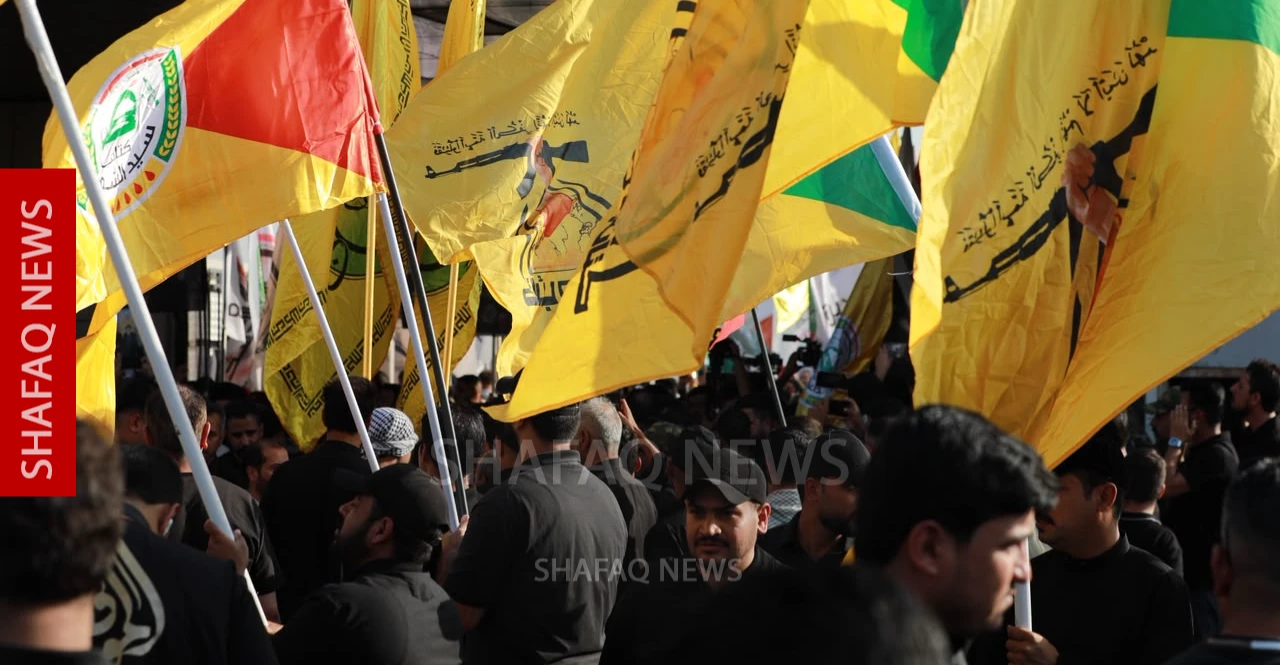
Since February 28, 2026, when the United States and Israel launched their war on Iran, Iraqi groups have claimed responsibility for hundreds of attacks on US bases and interests in Iraq and the region before their threats expanded to include Gulf states. Among the most prominent groups in this context are Kataib Hezbollah, which has repeatedly declared its affiliation with the Axis Of Resistance —the Iran-led regional alliance of allied states and armed groups— and adopted rhetoric hostile to the US presence; Harakat al-Nujaba, which maintains an armed wing and is considered one of the factions closest to Iran; and Kataib Sayyid al-Shuhada, which rejects relinquishing its military capabilities outside full state control.
Positions diverge, however, on the issue of restricting weapons to the state: some factions have shown willingness to engage politically or reorganize their relationship with the state, while others refuse to give up their arsenals, viewing them as part of their ideological and regional role. Asaib Ahl al-Haq, by contrast, has moved further into formal political life, placing it in a more delicate position between political engagement and retaining military influence.
Read more: Iraq's September deadline undercuts armed factions' case for weapons
Iran's Network of Influence
Observers interviewed by Shafaq News view these factions as part of a broader regional network backed by Iran, which uses them as leverage against the United States and its allies. Security expert and strategic analyst Alaa al-Nashou expressed that Iraq has become a "battlefield" because of the direct war between the United States and Iran that erupted on February 28, 2026, "with Tehran viewing the Iraqi arena as an influential card in any confrontation with Washington."
He noted that the presence of an "Iran-linked military arsenal inside Iraq," and its ability to strike targets Tehran considers relevant to the conflict, has made the country part of the wider regional confrontation equation. "The problem lies in the fact that some of the targets these factions strike are located inside neighboring Arab states bound to Iraq by ties, borders and agreements," he said, adding that this factor places Baghdad before legal and political responsibilities toward those states.
Iranian influence within parts of Iraq's security and military apparatus, he argued, has placed the government in a difficult position and given neighboring states, particularly Arab ones, justification to act against threats emanating from Iraqi territory. Al-Nashou noted that these factions "fall under the authority of the commander-in-chief of the armed forces" according to law and the constitution, placing the Iraqi government under a legal responsibility to prevent any military activity outside the state's decision.
"Any military action by neighboring states inside Iraqi territory represents a violation of Iraqi sovereignty, but respect for Iraq's sovereignty must be matched by Iraq's respect for the sovereignty of other states and by preventing its territory from being used to launch attacks against them."
Al-Nashou warned that continuation along this path risks dragging Iraq and its people into a conflict that serves no national interest, emphasizing that the country's distance from regional and international wars is "the pinnacle of patriotism."
The Language of Sovereignty
For their part, Iran-aligned armed factions reject characterizations of Iraq as an open arena for foreign interference.
Hussein al-Shihani, a member of the political bureau of the Sadiqoon Movement, led by Qais al-Khazali, refused, in an interview with Shafaq News, that Iraq is "a violable arena, nor a state without a decision," affirming that any assault on Iraqi territory constitutes an assault on its sovereignty.
"Iraq possesses institutions and armed forces capable of defending it," he said, stressing support for building a strong state and keeping the decision of war and peace exclusively in the government's hands. At the same time, al-Shihani insisted that calls for state-building should not be understood as weakness or retreat in the face of external threats. The factions, he said, "do not want escalation, but they do not fear it either," warning any party considering aggression against Iraq that it would bear the consequences, while calling for a more effective and prominent Iraqi diplomatic role commensurate with the scale of regional and international developments.
That confidence sits uneasily against the facts on the ground. Baghdad bears constitutional responsibility for forces it does not fully command, while its neighbors have shown they will strike inside Iraq without waiting for it to act, and the war between Iran and a US-Israeli coalition has narrowed the diplomatic space every party still invokes. Al-Zaidi's government has ordered committees and raised readiness, but whether it can close the gap between the state's formal authority and the factions' operational autonomy is the question the next attack, from whichever direction, will answer.
Read more: Lebanon's Hezbollah shifts from battlefield to political fight over weapons
Written and edited by Shafaq News staff.