Iraq’s speakership: Two decades of constitutional rules and backroom deals


Shafaq News
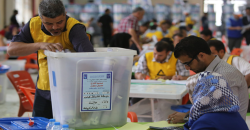
Since Iraq adopted its 2005 constitution, electing the Speaker of the Council of Representatives has followed a clear constitutional formula: a secret ballot and an absolute majority of the full parliament. Yet two decades of parliamentary experience reveal that the process has rarely been straightforward.
Beneath the legal framework lies a political reality shaped by informal power-sharing, behind-the-scenes deals, repeated voting rounds, prolonged deadlock, and, more recently, direct judicial intervention that has ended a sitting Speaker’s term. The result is a position chosen as much by consensus as by counting votes.
The Unwritten Pact
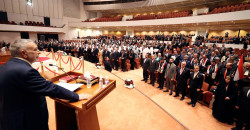
Article 55 of the 2005 constitution requires that the Speaker and two deputies be elected by a direct secret ballot, obtaining an absolute majority of all lawmakers. The vote occurs during parliament’s first session after elections, although additional sessions may follow if no candidate achieves the necessary majority. Quorum itself also demands the presence of an absolute majority of members.
Legally, the constitution does not refer to sectarian or ethnic allocation. In practice, however, a post-2003 political convention has taken hold: the speakership goes to a Sunni Arab, the premiership to Shiite political forces, and the presidency to Kurdish parties. Though unwritten and non-binding, this arrangement has become a cornerstone of Iraq’s political system and has shaped every parliamentary cycle since.
The Magic 165
With the parliament currently composed of 329 seats, electing a Speaker requires at least 165 votes — half of the total membership, plus one. This threshold applies regardless of how many lawmakers attend the session, provided a quorum is met.
In earlier parliamentary terms, the required number varied depending on the size of parliament at the time. While the constitution sets the voting threshold, it does not specify runoff procedures, leaving parliament to rely on political custom. As a result, Speaker elections have often stretched across multiple rounds or been postponed to later sessions until a candidate finally secured enough backing.
In December 2023, the Federal Supreme Court intervened, ruling that parliament is not required to complete the Speaker’s election in its first session, and that legislative work may continue even if the post remains vacant — a decision reinforcing institutional continuity during political paralysis.
Read more: Iraq's new parliament: No bloc can impose, none can be ignored
How Iraq’s Speakers Were Chosen — Term by Term
Transitional National Assembly (2005)
In April 2005, during Iraq’s interim political phase, lawmakers elected Hajim Al-Hassani as Speaker of the Transitional National Assembly. The vote was conducted by secret ballot under transitional legal arrangements, before the permanent constitution came into force. While records confirm the vote-based process, detailed tallies from that period were not consistently published.
First Constitutional Term (2006–2010)
Parliament elected Mahmoud Al-Mashhadani as Speaker on April 22, 2006, marking the first speakership under the new constitution. Official data released by the Parliament media office indicated that he secured around 159 votes out of a 275-seat parliament, exceeding the absolute majority required at the time.
His tenure was turbulent, marked by repeated disputes inside parliament, suspended sessions, and political tension. In December 2008, Al-Mashhadani resigned before completing the term.
What followed was one of parliament’s earliest tests of fragmentation. With the same 275-seat chamber unable to agree on a successor, multiple attempts to elect a new Speaker failed over several months. It was only on April 19, 2009, after delayed sessions and repeated voting rounds, that lawmakers elected Ayad Al-Samarrai. He secured 153 votes out of 232 MPs present — as 43 lawmakers did not attend — ending the deadlock and illustrating how fragmentation could stall even constitutionally defined processes.
Second Constitutional Term (2010–2014)
The 2010 elections brought a reformed parliament of 325 seats, raising the absolute majority threshold accordingly. On November 11, 2010, parliament elected Osama Al-Nujaifi as Speaker with a decisive 227 votes. His election formed part of a broader political deal that ended months of gridlock after the March 2010 elections.
Unlike his predecessors, Al-Nujaifi completed the full term, reflecting a period when cross-bloc consensus translated into institutional stability.
Third Constitutional Term (2014–2018)
The same 325-seat structure carried into the 2014–2018 parliamentary term. In July 2014, lawmakers elected Salim Al-Jubouri as Speaker with 194 votes, backed by broad support from major parliamentary blocs. His tenure unfolded during a period of acute national security challenges, yet the speakership itself remained stable throughout the term — another instance where political agreement shielded the institution from disruption.
Fourth Constitutional Term (2018–2022)
Ahead of the 2018 vote, an electoral reform expanded parliament to 329 seats, increasing the absolute majority requirement. This election ushered in a more fractured parliament, and early sessions failed to produce agreement on a Speaker. On September 15, 2018, after multiple rounds of voting, Mohammed Al-Halbousi was elected with 169 votes, becoming the youngest figure to occupy the post.
Fifth Constitutional Term (2022–2025)
When the newly elected 329-seat parliament convened on January 9, 2022, lawmakers re-elected Al-Halbousi for a second term. He secured 200 votes in the first round — a result widely attributed to renewed political understanding among major blocs.
That stability proved short-lived. On November 14, 2023, the Federal Supreme Court terminated Al-Halbousi’s parliamentary membership over a legal case involving allegations of forging a lawmaker’s resignation letter, which he denied. This decision created an unprecedented situation: a sitting Speaker removed by judicial order, leaving the post vacant as a deputy speaker presided over sessions.
After nearly a year of political stalemate, parliament re-elected Mahmoud Al-Mashhadani on October 31, 2024. He won 182 votes, following multiple rounds in which no candidate initially reached the absolute majority. His return underscored two enduring features of Iraq’s parliamentary life: prolonged deadlock during periods of fragmentation, and a tendency to fall back on experienced figures when consensus proves elusive.
Sixth Constitutional Term (2025–)
With Iraq concluding its sixth parliamentary elections on 11 November 2025, the newly elected legislature now faces the task of selecting its next parliament speaker. Following the elections, Sunni blocs sought to consolidate their influence by forming the National Political Council (NPC) — an umbrella framework intended to unify major Sunni players like the Coordination Framework (CF), which functions among Shiite factions.
The NPC brings together a wide range of Sunni forces, including the Taqaddum Party (Progress) led by former Speaker Al-Halbousi, the Al-Azm Party (Determination) headed by Muthanna Al-Samarrai, the Sovereignty Alliance (Al-Siyada) under Khamis Al-Khanjar, as well as the Al-Hasm National Alliance and the Al-Jamaheer Al-Wataniya Party.
Despite this appearance of unity, long-standing rivalries remain unresolved. Taqaddum emerged from the elections as the largest Sunni bloc with 27 deputies and is pushing to reclaim the speakership. Al-Azm, which secured 15 seats and has frequently clashed with Al-Halbousi, continues to be a major obstacle.
Other contenders have also emerged, including former Education Minister Mohammed Tamim, Defense Minister Thabet Al-Abbasi, MP Salem Al-Issawi, and MP Mahmoud Al-Qaisi.
The path to electing a speaker is further complicated under the new parliamentary arithmetic. Failing to secure the 165 votes required could delay the decision to be taken in the first parliamentary session scheduled for 29 December or force Sunni blocs into last-minute compromises that reshape the distribution of committee chairs and ministerial portfolios.
If the Sunni component fails to coalesce around a single speaker, the parliament cannot begin normal legislative work, and the presidency vote may be postponed. At the same time, other components — Shiites and Kurds — cannot constitutionally impose a speaker from outside the Sunni community, even if they hold enough votes.
The likely outcome is either a forced Sunni–Sunni compromise or a return to the model used in 2018 and 2022: a cross-component deal in which the CF and Kurdish blocs guide Sunnis toward a single acceptable choice. Should Sunni rivalry intensify, some blocs might attempt to advance a surprise Sunni candidate supported by non-Sunni forces, but this carries the risk of significant political backlash within the Sunni Street.
A Fragile Balance
Across five parliamentary terms, a consistent pattern has emerged. While the constitutional rules governing the speakership have remained unchanged, the outcomes have depended almost entirely on political alignments.
When major blocs reached early agreements — as in 2010, 2014, and early 2022 — the election of the Speaker proceeded swiftly. By contrast, when fragmentation prevailed, the process dragged on, as seen in 2009, 2018, and 2024. Judicial intervention, once considered unthinkable, has become a recurring factor, culminating in the termination of Al-Halbousi’s mandate in 2023.
As Iraq approaches the first parliamentary session on 29 December, the new term is poised to test once again the delicate balance between constitutional procedure and political bargaining in one of the country’s most contested parliamentary posts.
Read more: New term, new battle: Six candidates chase Iraq’s speakership
Written and edited by Shafaq News staff.