Iraq's political crossroads: Al-Sadr's boycott, Al-Hakim's mediation


As Iraq prepares for its parliamentary elections in November 2025, an uncertainty surrounds the political scene: Will influential Shiite leader Muqtada al-Sadr participate, or will his boycott continue to shape the electoral process—and its legitimacy?
Al-Sadr’s firm stance, grounded in his demand for sweeping reforms and an end to entrenched corruption, has not wavered. His absence threatens to depress voter turnout and undercut the credibility of the elections. Meanwhile, rival Shiite factions have turned to a seasoned intermediary—Ammar al-Hakim—in a last-ditch effort to bring the powerful cleric back into the fold.
Al-Sadr’s Position: Non-Negotiable Demands?
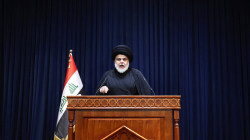
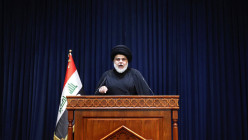
Al-Sadr has reiterated, in increasingly stark terms, his refusal to engage in what he describes as a fundamentally corrupt political process. His withdrawal from parliament in June 2022, when his movement relinquished 73 seats, was just the beginning of a broader political retreat.
Since then, Al-Sadr has maintained a consistent message: “the current system cannot be salvaged without radical reform.”
In a statement issued last Friday, he outlined a set of stringent conditions that he views as prerequisites for any potential return to the political process. Central among them is the disarmament of all “militias” and the transfer of their weapons to the control of the state. He also called for the reinforcement of the country’s official military and police institutions, underscoring the need for a unified, state-run security apparatus.
Additionally, Al-Sadr emphasized the importance of preserving Iraq’s independence by rejecting all forms of external alignment or influence.
Finally, he demanded comprehensive anti-corruption measures, including the prosecution of officials involved in graft and the dismantling of the entrenched systems that enable it.
These stipulations reflect a maximalist position that few believe Iraq’s entrenched political class is prepared to meet. His rhetoric portrays a country in existential decline, once warning that Iraq is “living its last breaths”—a sentiment that resonates with segments of a disillusioned public.
Al-Hakim’s Mediation: A Narrow Path
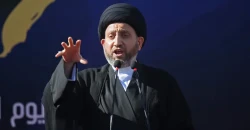
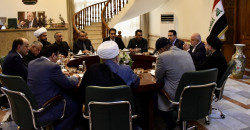
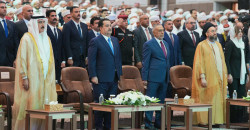
In response to Al-Sadr’s absence, the Shiite Coordination Framework has quietly enlisted Ammar al-Hakim, head of the National Wisdom Movement (Al-Hikma), to mediate. Al-Hakim, whose political base lies in Baghdad’s Al-Jaderiyah district, is viewed as one of the few figures with enough credibility and political capital to potentially engage with al-Sadr.
Yet the odds are stacked against him. Political analyst Ali Hussein al-Fatlawi, affiliated with the State Support Alliance, told Shafaq News that “Al-Sadr’s vision is fundamentally incompatible with the Coordination Framework.” He argued that the ideological divide is too vast, and that al-Hakim’s role, while symbolic, is unlikely to yield concrete results.
Atheer al-Sharaa, another political analyst, echoed this skepticism. In remarks to Shafaq News, he pointed to Al-Sadr’s consistent messages via his X account, emphasizing the cleric’s resolve. “His conditions are painful and, in some cases, unachievable,” said al-Sharaa, particularly the demand for armed factions to disarm, many of which are integral to the Coordination Framework’s power base.
Strategic Stakes and Electoral Consequences
Al-Sadr’s continued boycott carries profound electoral consequences. His political base commands a loyal following, and his absence from the ballot could siphon over a million votes from the system. Al-Fatlawi warned that such a shortfall would significantly lower turnout, and undermining the election’s credibility.
But the stakes go beyond numbers. Al-Sharaa raised concerns that mass Sadrist mobilizations—particularly during religious events like the Ashura pilgrimage in Karbala—could evolve into political demonstrations. Such scenarios, especially in Baghdad, “risk destabilizing the electoral timetable and may even force a postponement.”
Tensions escalated further when the al-Nasr Coalition, led by former Prime Minister Haider al-Abadi, announced its withdrawal from the election process, citing similar concerns over corruption and the lack of electoral reform. This move highlighted the growing disillusionment within even the establishment political blocs.
Expert Views: A Political Process “In A Maze”
Ali al-Saheb, a political analyst revealed to Shafaq News that Sadr’s demands apply broadly—not just to rival factions but also to his armed group, Saraya al-Salam, and even the Kurdish Peshmerga. This rare consistency, he argued, "illustrates Al-Sadr’s sincerity but also reinforces the unlikelihood of compromise."
“The political process has entered a maze,” al-Saheb warned, pointing to the closure of candidate registration and the lack of a roadmap for real reforms. “Unless a breakthrough occurs, either through external mediation or internal restructuring, Iraq may face either a contested election or another postponement.
An Unstable Path to the Ballot Box
The months leading to the November 2025 elections are shaping up to be among the most turbulent in Iraq’s post-2003 political history. Al-Sadr’s continued boycott not only deprives the elections of legitimacy but also weakens the broader system’s capacity to absorb dissent and project stability.
While al-Hakim’s mediation remains the Coordination Framework’s last viable channel, the deep ideological rift and non-negotiable demands leave little room for optimism.
Written and edited by Shafaq News Staff.