Iraq’s Presidential Race: Kurdish candidates competing for the post


Shafaq News– Baghdad
Iraq’s presidential race has entered a decisive phase with tens of candidates officially registered, but political negotiations and parliamentary arithmetic have narrowed real competition to a small group of senior Kurdish figures, reflecting an intensifying rivalry between the Kurdistan Democratic Party (KDP) and the Patriotic Union of Kurdistan (PUK).
Parliament Speaker Haibet al-Halbousi said on Monday that the nomination window for the presidency had closed at the end of the official working day, confirming that 44 candidates had submitted applications.
Although dozens of names are on the ballot, political talks have centered on a limited number of heavyweight candidates put forward by the two dominant Kurdish parties.
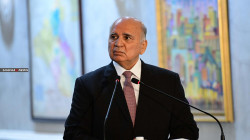
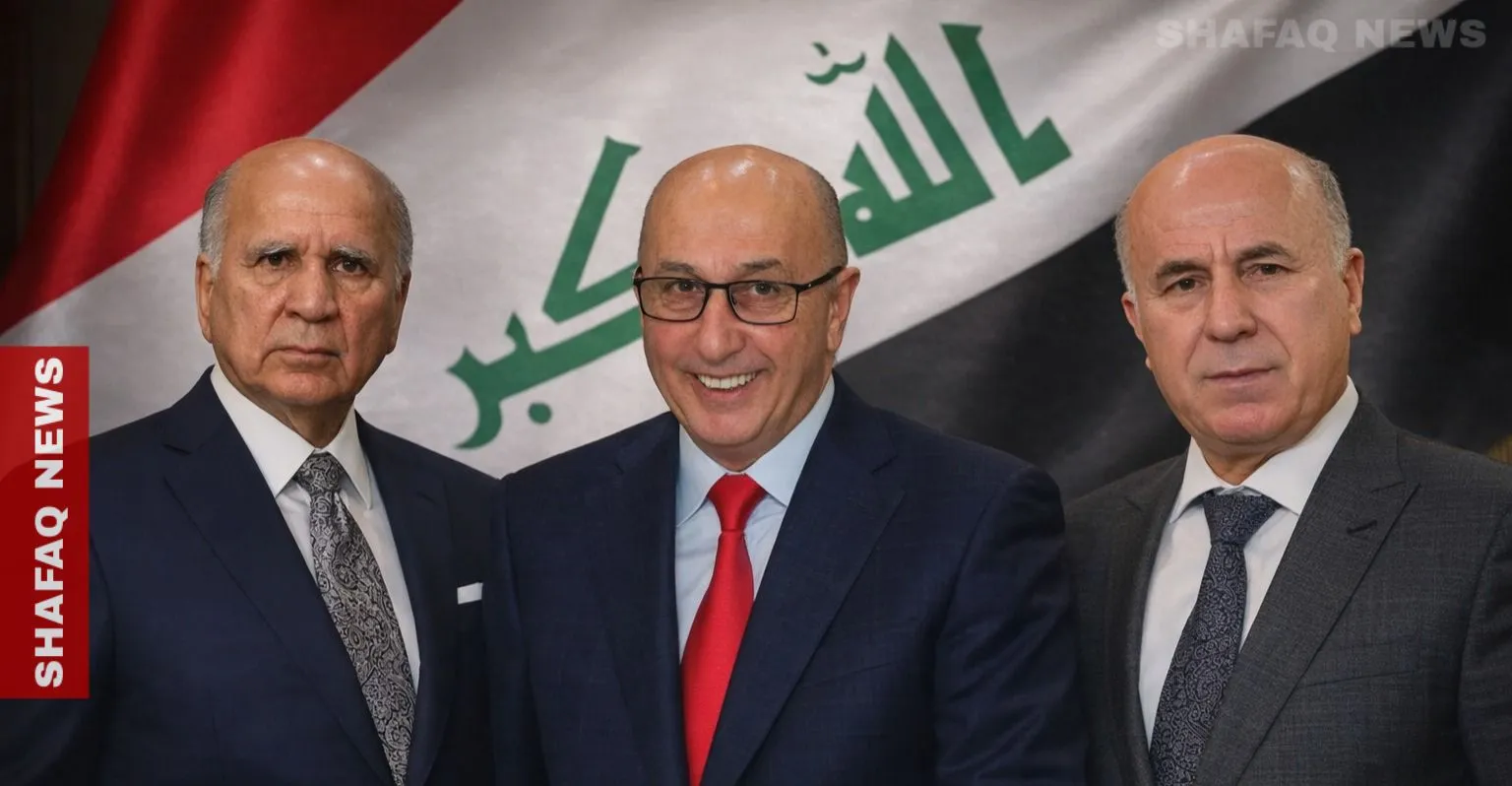
One of the most prominent figures is Fuad Hussein, Iraq’s current foreign minister. A veteran Kurdish politician, Hussein has held senior posts at both the federal and Kurdistan Region levels, including finance minister and deputy prime minister. He previously served as head of the Kurdistan Region Presidency’s Diwan for more than a decade and is regarded as an experienced figure in diplomacy and state administration. Hussein is fluent in Kurdish, Arabic, Persian, English, and Dutch.
Another leading contender linked to the Kurdistan Democratic Party is Nawzad Hadi, the former governor of Erbil province. Hadi held the post from 2004 until 2019 and has been an active member of the KDP since the early 1990s. Trained as an electrical engineer, he has held senior party leadership roles, including membership in the KDP’s political bureau, and is known for his long administrative experience in the Kurdistan Region.
The Patriotic Union of Kurdistan has nominated only Nizar Amedi, a senior party leader and former federal environment minister. Amedi resigned from his ministerial post in 2024 to focus on political and party work. He currently heads the PUK’s political bureau in Baghdad and is a member of the State Administration Coalition. Amedi holds a degree in mechanical engineering and has played a growing role in the PUK’s federal-level strategy.
He previously served as chief of staff to the current President Abdul Latif Jamal Rashid in 2022, and held the same post under former President Barham Salih between 2018 and 2022. He also acted as the president’s representative to the Council of Ministers.
Earlier in his career, Amedi headed the office of former President Fuad Masum from 2014 to 2018, and served as chief of staff to the late President Jalal Talabani between 2008 and 2014. From 2005 to 2008, he worked as Talabani’s personal secretary, placing him among a small circle of officials with long-standing institutional experience at the heart of Iraq’s presidency.
Since 2005, Iraq’s presidency has traditionally been held by a Kurd, with the position largely going to the Patriotic Union of Kurdistan under informal power-sharing arrangements. However, the Kurdistan Democratic Party now argues that its stronger showing in the November 2025 parliamentary elections —where it secured more than one million votes— gives it a legitimate claim to the post.
This shift has turned the presidency into a contested prize between the two Kurdish parties, rather than a largely settled entitlement, complicating efforts to present a unified Kurdish candidate to Baghdad.
Under Iraq’s constitution, the president is elected by the 329-member Council of Representatives. A special parliamentary session must be held with a quorum of two-thirds of lawmakers (219 members.)
In the first round, a candidate must secure a two-thirds majority to win. If no candidate reaches that threshold, a second round is held between the two candidates with the highest votes, with the winner decided by a simple majority. The elected president then takes the constitutional oath and formally assumes office.
The presidency is a key step in Iraq’s post-election process. Once elected, the president must task the nominee of the largest parliamentary bloc with forming a government within 15 days.
In November 2025, the Coordination Framework —an alliance of mostly Shiite parties—presented itself as the largest bloc after winning more than 175 seats. This gives it significant leverage in shaping the presidential outcome. The alliance has urged Kurdish parties to agree on a single nominee, but talks have so far failed to resolve the rivalry.
The current parliamentary term held its first session on December 29, 2025. Under the constitution, this sets January 28, 2026, as the final deadline for electing the president. Political sources say the vote could be held earlier if a consensus emerges among major blocs.
Written and edited by Shafaq News staff.