Iraq’s 2025 Elections: Revised law reshapes the path to power


Shafaq News – Baghdad
Iraq’s parliamentary elections, scheduled for November 2025, will be held under the amended Election Law No. 9 of 2020, which restores the Sainte-Laguë formula and larger electoral districts—a move widely seen as favoring established political blocs over independents.
The March 2023 amendments reversed earlier reforms that had divided provinces into multiple smaller districts and briefly opened space for independent candidates. Those 2021 reforms had enabled a surge of new political movements and unaffiliated contenders to win unprecedented representation in parliament.
Under the reinstated system, votes will again be counted using the Sainte-Laguë method, with a key modification: the first divisor is set at 1.7 instead of 1.0. This adjustment raises the vote threshold for the first seat in each district, giving a clear advantage to larger lists. Combined with the return to closed party lists, the change effectively narrows the path for independents and civic candidates who had gained ground in 2021.
Supporters of the amendment, including leaders within the Shiite Coordination Framework alliance, argue that the new law will enhance political cohesion and stabilize governance. Critics counter that it undermines voter choice and reverses one of Iraq’s few post-2019 protest-driven reforms.
In February 2024, Iraq’s Federal Supreme Court issued a ruling requiring elections in the Kurdistan Region to be held across four constituencies instead of a single regional district. Parliament later aligned the national election law with that decision, reshaping the electoral map in the north.
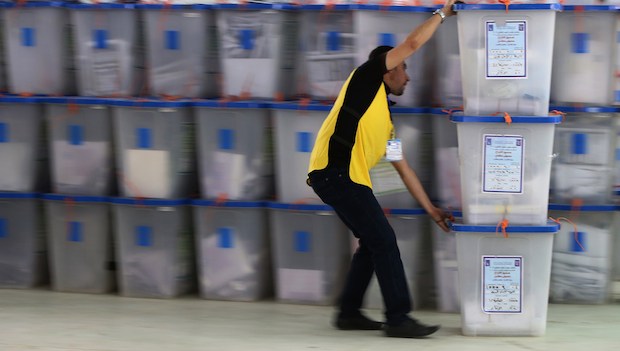
The Independent High Electoral Commission (IHEC) has begun preparing logistical frameworks and updating voter rolls under the amended structure. Legal changes have also expanded its authority to implement the formula and monitor compliance with gender and minority quotas.
Inside Iraq’s Electoral Mechanics
Each province functions as a single electoral district. Seat allocation follows the modified Sainte-Laguë formula, beginning with a divisor of 1.7. The total number of valid votes in the province is divided by its allocated seats to determine the electoral quotient—the number of votes required for one seat. Seats are then distributed proportionally among political lists, with candidates holding the highest personal vote totals receiving the seats first.
Once the quotient is established, the highest-voted candidates within each successful list take the available seats.
At least 25% of parliamentary seats are reserved for women. If direct voting falls short of that quota, the next-highest female candidates are elevated to meet it.
Nine seats are reserved—five for Christians and one each for Yazidis, Shabaks, Mandaeans, and Feyli Kurds.
The higher divisor functions as a “soft threshold,” slowing smaller parties without fully excluding them. By requiring more votes for the first seat, the method reduces fragmentation and rewards cohesive blocs while keeping proportionality intact through subsequent divisors (3, 5, 7, etc.).
Minority candidates compete nationwide rather than within provincial lists. Any voter may cast a ballot for them, and the candidate with the most votes in each category wins. Critics argue this system allows dominant sectarian parties to influence minority outcomes and have urged reforms limiting voting on quota seats to members of those communities.
Read more: Iraq’s 2025 Parliamentary Elections — What You Need to Know
Written and edited by Shafaq News staff.