Iraq begins 90-day countdown to form government as political fault lines re-emerge



Shafaq News
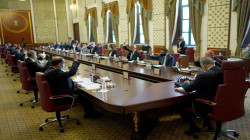
With the Federal Supreme Court ratifying the final results of Iraq’s sixth parliamentary elections, the country has formally crossed from the electoral phase into the far more consequential battle of power formation. Constitutionally, the path ahead appears clear and tightly timed. Politically, however, Iraq is entering a familiar zone of uncertainty where deadlines often collide with entrenched rivalries, veto power, and fragile consensus-building.
The court’s approval is not a procedural formality. Under Article 93 (Seventh) of the 2005 constitution, it is the decisive legal act that gives binding force to the election results and activates the timetable for forming the three constitutional authorities: the legislature, the presidency, and the executive branch. What unfolds in the coming weeks will determine whether Iraq can finally translate constitutional text into political discipline—or once again drift into prolonged paralysis.
From Certification to Parliament
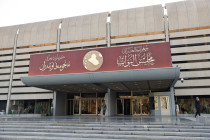
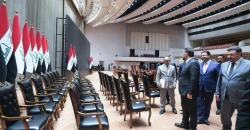
With the Federal Supreme Court’s ruling now issued, Iraq’s constitutional timetable has formally taken effect. The constitution obliges the president to invite lawmakers to their first parliamentary session within 15 days of ratification. In line with this requirement, President Abdul Latif Rashid issued a republican decree setting December 29 as the date for the inaugural session of the newly elected Council of Representatives.
Legal expert Nawfal Al-Hayani stressed that parliament does not legally exist before the court’s ratification, rendering any actions taken before that point constitutionally void. Should the president fail to issue such an invitation, the legislature would convene automatically on the sixteenth day, chaired by the oldest member of parliament, Tasmeem Alliance MP Amer Al-Fayez, in accordance with constitutional procedure.
The inaugural session itself carries a narrowly defined mandate: administering the constitutional oath and electing the speaker and two deputies. Completion of this step formally establishes the legislative authority and unlocks the next—and far more politically sensitive—phase of the process: electing the president of the republic.
Read more: Iraq's new parliament: Defining the next decade
The Presidency: Iraq’s Political Chokepoint
Legal expert Mohammad Jumaa noted that once the Speaker of Parliament is elected, the incumbent president loses any constitutional basis to continue exercising his duties, transforming the presidency from a largely ceremonial role into a decisive institutional threshold.
Under Article 70 of the constitution, parliament must elect a new president within 30 days of its first session, a process that requires a two-thirds majority—220 out of 329 lawmakers. While the office itself carries limited executive authority, its role is structurally pivotal. Without a president, no prime minister can be nominated, and the entire government formation process comes to a standstill.
Legal analyst Abbas Al-Aqabi warned that missing this deadline would plunge Iraq into a constitutional vacuum, freezing presidential powers and suspending executive formation. Such a scenario, he cautioned, could force extraordinary measures, including extending parliament’s term or moving toward early elections.
“Previous attempts by the Council of Representatives to bypass constitutional deadlines through the so-called ‘open session’ tactic have been explicitly rejected by the Federal Supreme Court,” Jumaa told Shafaq News. He added that the Supreme Judicial Council has reaffirmed the binding nature of these timelines, leaving no legal room for reinterpretation. Failure to elect a president within 30 days of the Speaker’s election, he said, would automatically trigger a constitutional vacuum.
The risk is not theoretical. Since 2005, the presidency has been allocated to the Kurdish component by political convention, yet rivalry between the Kurdistan Democratic Party (KDP) and the Patriotic Union of Kurdistan (PUK) has repeatedly turned the post into a political pressure point. Ghazi Faisal, head of the Iraqi Center for Strategic Studies, noted that while the PUK traditionally claims the position, the KDP argues that its electoral weight—exceeding one million votes—entitles it to compete.
If both parties put forward rival candidates, the two-thirds quorum requirement revives the specter of the “blocking third,” allowing any coalition with more than 109 MPs to derail the session by denying quorum—a tactic that paralyzed Iraq’s political process after the 2021 elections.
Read more: Five contenders eye Iraq's top post: PM selection looms
Shiite Majority, Internal Balancing
On paper, the Shiite Coordination Framework enters this phase from a position of dominance. Following the accession of Prime Minister Mohammed Shia Al-Sudani’s Construction and Development Coalition (Al-Ima’ar Wal Tanmiyah,) the framework claims more than 175 seats, making it the largest parliamentary bloc and constitutionally entitled to nominate the prime minister.
Yet numerical strength does not guarantee internal consensus. According to Shafaq News sources, the framework is weighing multiple candidates, including Al-Sudani, former Prime Minister Haider Al-Abadi, and a third, as-yet-unannounced figure. Earlier criteria barring bloc leaders from the premiership were quietly eased, reopening competition among major factions.
This internal balancing act reflects Iraq’s executive leadership, which is rarely decided by electoral results alone, but by negotiated accommodation within the dominant Shiite camp—often before formal constitutional steps are completed.
Sunni Arena: Agreement or Appearance?
Within the Sunni component, the speakership appears closer to resolution—but not without friction. Sovereignty Party (Al-Siyada) leader Nawaf Al-Ghariri said the post had been settled in favor of Mohammed Al-Halbousi, a claim contested by former MP Bassem Khashan, who continues to cite a prior Federal Supreme Court ruling that removed Al-Halbousi from office.
Although the judiciary cleared Al-Halbousi of forgery charges in April 2025—allowing his return to electoral politics—the controversy underscores lingering divisions. Meanwhile, the Sunni National Political Council has narrowed its list of candidates to three names, with reports of near-consensus around Muthanna Al-Samarrai, alongside Al-Halbousi and Thabet Al-Abbasi.
The outcome will test whether Sunni forces can present a unified front or whether internal rivalries will complicate the broader power-sharing equation.
Deadlines on Paper, Delays in Practice
Iraq’s constitution establishes a cumulative ceiling of 90 days to complete government formation—from ratification to parliamentary confidence in the cabinet. In theory, these periods are non-extendable. In practice, Iraq’s post-2003 experience tells a different story.
After the 2010 elections, disputes over the “largest bloc” delayed government formation by more than seven months. In 2020, Mohammed Tawfiq Allawi failed to form a cabinet despite being formally designated. Following the 2021 vote, Iraq endured a nine-month political vacuum that ended only after mass protests, deadly clashes, and Muqtada Al-Sadr’s withdrawal from parliament, paving the way for Abdul Latif Rashid’s election and Al-Sudani’s appointment in October 2022.
These precedents have normalized delay, weakening the deterrent effect of constitutional deadlines.
Consensus Still Uncertain
Members of the Coordination Framework, including State of Law Coalition figure Imran Al-Karkoushi, expressed to Shafaq News optimism that this cycle will proceed smoothly and within legal limits. Kurdish Democratic Party official Wafa Mohammed Karim, however, cautioned that past failures to “respect “constitutional timelines—especially on the presidency—remain a warning sign.
“If the Kurdistan Democratic Party and the Patriotic Union of Kurdistan agree on a single candidate for the presidency, the process could move forward more quickly,” Karim told Shafaq News. “But if both parties put forward separate nominees, they will be forced to seek alliances with other political forces, which would inevitably prolong the process.”
At its core, Iraq’s political system operates on consensus across sectarian and ethnic lines, yet relies on constitutional mechanisms that empower minorities to block outcomes. This tension—between inclusivity and efficiency—has repeatedly produced stalemate.
The Federal Supreme Court has now done its part. Whether Iraq’s political actors can do theirs will shape not only the next government, but also the credibility of the constitutional order itself. As the clock ticks, the focus shifts from what the constitution requires to whether Iraq’s political class is willing to allow it to govern.
Read more: New term, new battle: Six candidates chase Iraq’s speakership
Written and edited by Shafaq News staff.