In Kirkuk’s cafés, Iraqi women shatter the smoking taboo


Shafaq News
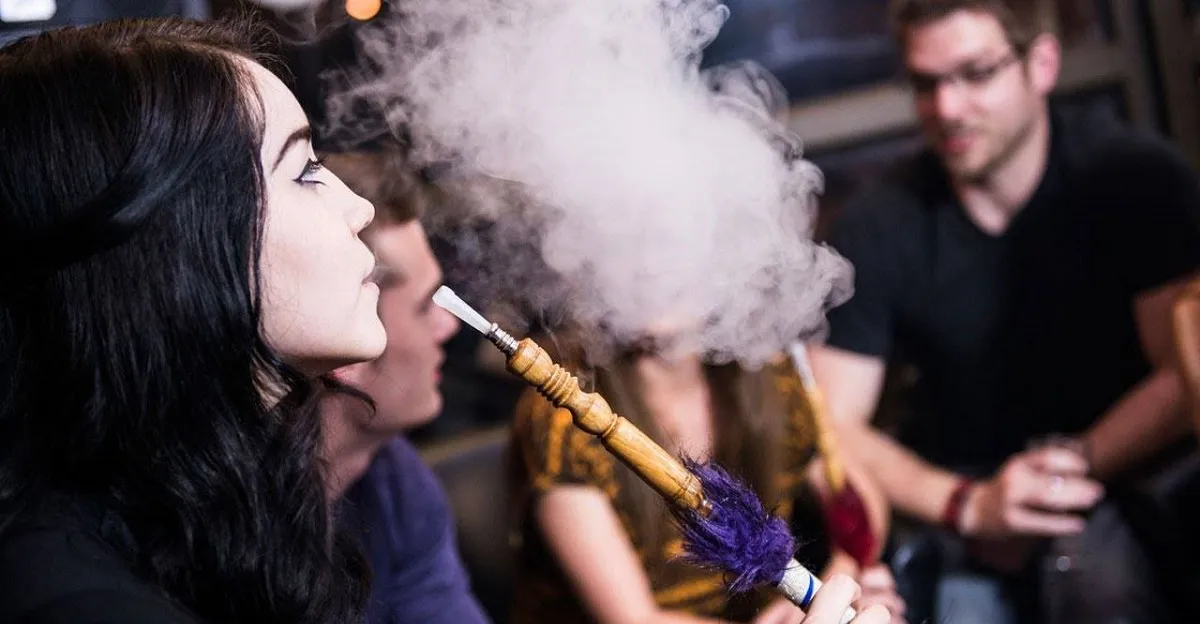
The government employee drops into her café chair, ID badge still clipped to her purse. A waiter lowers an ornate hookah, its glass base catching the late-afternoon light. She draws in the fruit-scented smoke, the coals crackling, and exhales a white cloud that drifts above the chatter around her. Across the room, other women do the same.
Kirkuk no longer hides what it once condemned; women now smoke openly, dismantling a taboo that ruled behavior for generations. What was whispered about behind closed doors unfolds in daylight, unnoticed by a younger generation quietly redefining normal.
The Habit That Got Freed
Samar Mohammed, 28, remembers the first spark. “Three years ago, friends at a women’s gathering suggested trying hookah,” she told Shafaq News. “We thought it would be once, maybe twice. But twice became habit.”
“We used to hide our smoking, afraid of what people would say. Now it’s normal,” she continued. “Most of my colleagues try hookah after work. Nobody thinks twice about it.”
In a few short years, whispers gave way to open laughter in cafés where women now fill the seats once reserved for men. “Smoking has become entertainment—a way to release tension after long hours,” said Huda Khalid, another government employee. “Eight hours of bureaucracy—you just need to breathe.”
The Numbers Behind the Shift
According to the 2024 Tobacco Atlas, about 19 percent of Iraqi adults smoke, including 2 percent of women—roughly 200,000 people nationwide. Ten years ago, women scarcely appeared in the data; today, the sharpest rise is among urban, educated women in their twenties and thirties.
The World Health Organization places the annual cost of tobacco at more than $1.5 billion in healthcare and lost productivity. Imports reflect the same appetite: 700 shipments of tobacco entered Iraq from 28 countries in 2024.
Across Kirkuk, that demand has reshaped the city’s social geography, where cafés with bright interiors, Wi-Fi, dessert menus, and women-only corners now line Baghdad Road, giving leisure an air of legitimacy.
“Five years ago, not a single woman requested a hookah,” a café owner who asked not to be named stressed. “Now a third of my customers are women—employees, students, friend groups. They prefer fruit flavors. It’s not shameful anymore. That’s the difference.”
Maha Abdul Karim, 45, explained that these evenings are less defiance than reprieve. “We meet after work—four or five of us—and smoke fruit-flavored hookah,” she said. “It’s just relaxation after a long day.”
Such cafés have become rare refuges in Iraqi life: spaces where women can exist without purpose or permission—neither shopping nor supervising, simply present.
Freedom or Its Imitation
For Raghad Hassan, 33, the act itself is an argument. “I’ve smoked for three years—not because I’m addicted, but because I’m free,” she said. “If men can sit in cafés and smoke for hours, why can’t I?”
Her language—freedom, choice, autonomy—echoes the national conversation still unfolding two decades after the fall of Saddam Hussein's oppressive regime: who decides where women belong, and on what terms. In that debate, a hookah pipe can feel less like leisure than declaration, a quiet insistence on visibility.
Researcher Faris al-Bayati sees this new visibility as part of a larger cultural current, particularly after 2003, when women discovered new spaces for expression. “Cafés, social media, and global culture converged. Smoking became one symbol of that shift—a mirror of what they saw from Beirut to Istanbul.”
The same media that showcase women’s independence also package it, however, turning smoke and neon into an aesthetic of empowerment. Al-Bayati calls it “freedom designed for sale.”
The Price of Emancipation
At Kirkuk General Hospital, pulmonary specialist Dr. Saadoun al-Azzawi watches the cost of that calm appear on X-rays. “Hookah smoke is five to ten times heavier than cigarettes,” he explained. “People think water filters toxins or that flavors make it safer. Both ideas are false.”
He estimates that one hookah session—about 45 minutes—matches the smoke volume of a hundred cigarettes, with a mix carrying carbon monoxide, heavy metals, and carcinogens. He now treats women in their twenties and thirties for chronic coughs, infections, and asthma-like symptoms. Many, he said, are stunned to learn the connection.
His clinic’s charts show the pattern climbing year by year: more young women with tobacco-related respiratory disease, more early signs of lung damage. "The illusion of relaxation is costing them their lungs."
The World Health Organization attributes roughly 8 million deaths each year to smoking—more than a million from secondhand exposure alone. In Iraq, tobacco-linked heart disease, stroke, and cancer kill thousands annually, yet cessation programs remain rare and poorly funded.
Law Without Force
Iraq’s 2012 Anti-Tobacco Law No. 19 forbids smoking in public places in an attempt to curb such issues, but enforcement has long since evaporated. A Kirkuk health-department official described the system as “running on paper only.” Staff shortages, budget limits, and political indifference have left regulations dormant, while municipal café licenses often omit any clause on hookah service.
With no deterrent in place, cafés multiply, and many now target female customers directly, introducing mild flavors and pastel branding meant to soften hesitation and turn first-time curiosity into routine.
Progress or Paradox
To some Iraqis, the women filling cafés represent long-denied autonomy; to others, a generation misled by commerce. For women like Raghad Hassan, the smoke itself is proof of ownership—over time, space, and choice. For doctors, it’s a public-health warning already ignored.
Between those views lies modern Iraq: still negotiating what liberation costs and who decides its limits.
In a country once governed by rigid codes of visibility, even the ordinary can feel revolutionary. A café table shared after work, conversation unfiltered by family or fear—such gestures would have drawn scandal not long ago. Now they pass without comment.
The revolution, perhaps, is that ordinariness–whether it signals progress or peril depends on who is watching, but the sight of women claiming public space once reserved for men captures Iraq’s quiet transformation. It unfolds not in protests or policy, but in the steady rhythm of exhaled smoke—each breath a small act of ownership.
Yet as Wasan al-Azzawi observed, “The freedom that damages the body is still freedom—but it comes with a cost.”
Written and edited by Shafaq News staff.