Beyond the banners: Iraqi election slogans mask a crisis of economic vision


Shafaq News
With Iraq’s parliamentary elections set for November 11, 2025, politicians and analysts are warning that the ongoing campaign season lacks substance, as major parties rely on slogans and posters instead of presenting actionable economic programs to address the country’s deepening crises.
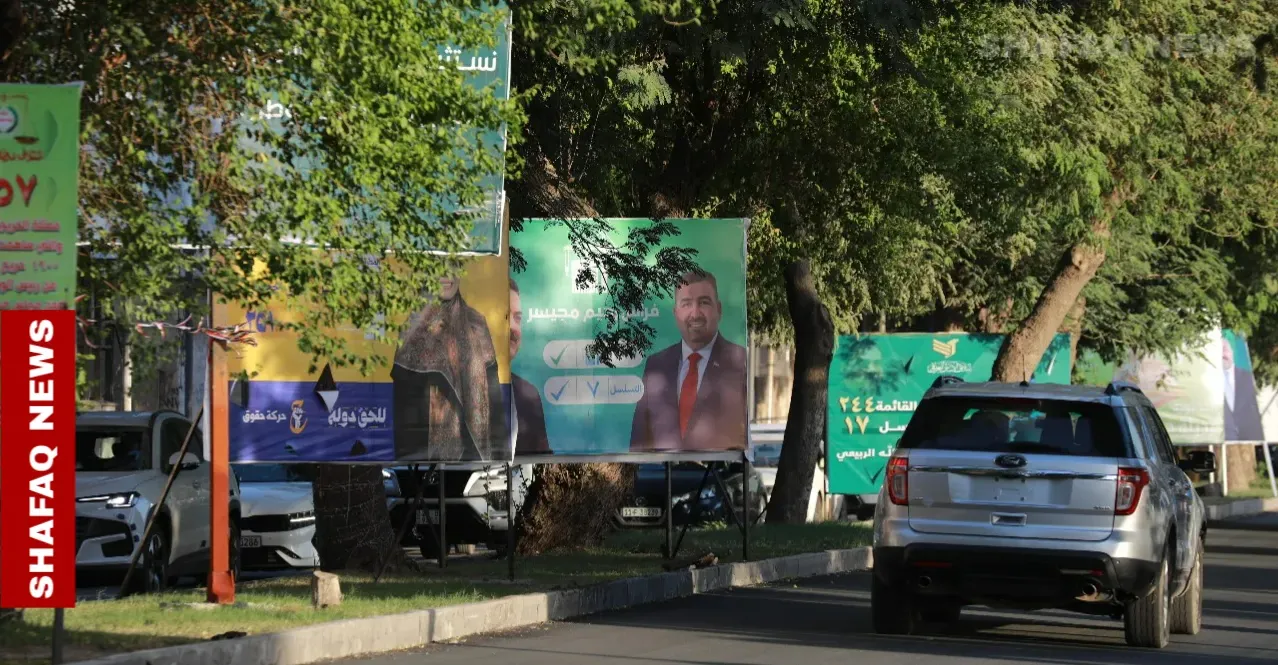
Since official campaigning began on October 3, Iraq's 19 provinces' streets have been covered with banners and portraits of candidates, many in violation of municipal regulations. The public spaces have turned into a visual battleground — a spectacle that reflects the intensity of competition but, critics say, not the quality of ideas.
Read more: Iraq’s 2025 Parliamentary Elections — What You Need to Know
Economic Challenges Ignored
The next parliament will inherit severe structural problems: water shortages, power failures, a bloated public sector, and near-total dependence on oil revenues, which make up more than 90 percent of state income. Despite these urgent issues, few parties have offered concrete policy proposals.
Independent MP Bassem Khashan told Shafaq News that most campaigns “lack seriousness and depth.”
“No candidate is discussing his electoral project objectively,” Khashan said. “Except for a few blocs that presented clear visions, the rest are simply racing to win votes without offering real solutions, especially to the economic problems facing Iraq.”
He described most campaign materials as “non-objective,” built around images and emotional slogans rather than structured programs.
Voters Losing Interest
Fahd al-Jubouri, a senior figure in the National Wisdom Movement (Al-Hikma) led by Ammar al-Hakim, said Iraq’s electoral scene has grown repetitive and shallow.
“Most political programs lack what the citizen truly needs — health, electricity, agriculture, industry, and education,” al-Jubouri told Shafaq News. “The same slogans are recycled every election cycle with no change in priorities or development of ideas.”
He acknowledged that public engagement is also declining, “Even citizens don’t read those programs seriously. A small elite may do so, but the majority don’t study candidates’ records. This is a shared flaw between the people and the political class.”
According to the Independent High Electoral Commission (IHEC), nearly 21.4 million Iraqis are eligible to vote this year. Yet observers note a growing sense of disillusionment, particularly among younger voters, after years of failed promises from successive governments.
Read more:Iraq’s Gen Z: Caught between a digital future and fragile realities
Economic Vision Missing
Political analyst Hussein al-Kanani told Shafaq News that the lack of economic literacy among candidates is one of the most troubling features of this election.
He considered the economic file to be the most pressing issue as Iraq still depends almost entirely on oil, with little diversification or foreign investment.
“Many candidates lack the capacity or knowledge to draw up an economic vision, relying instead on populist themes to attract votes,” he pointed out, warning that this “deficiency in electoral discourse” reflects a deeper problem of political competence and seriousness in addressing national challenges.
Calls for Reform-Oriented Agendas
Within the Sunni political sphere, Azzam al-Hamdani, a senior member of the al-Azm Alliance led by Muthanna al-Samarraei, said that Iraq has endured overlapping political, security, and economic crises that have hindered state-building efforts for years.
“Successive governments have made efforts to improve the general situation,” al-Hamdani told Shafaq News, “but the coming stage requires realistic reform visions from political forces.”
He emphasized that real progress depends on the quality of programs put forward by winning blocs. The solution and decision remain, according to him, in the hands of the political programs. “They must stem from a comprehensive national vision that establishes a new phase of economic, security, and political stability.”
Competition Without Transformation
Observers agree that unless Iraq’s political forces articulate credible reform programs that address the economy and governance, the upcoming elections risk becoming another cycle of symbolic competition without transformation.
Analyst al-Kanani concluded that the next government’s legitimacy will depend not only on voter turnout but on its ability to deliver tangible change, “If parties continue with empty slogans, Iraq will face the same stagnation — a state surviving on oil revenues, with no productive economy and no vision for its youth.”
Written and edited by Shafaq News staff.