Baghdad Won't Budge: Russia hails Iraq's rejection of West's anti-Moscow campaign


Shafaq News – Baghdad
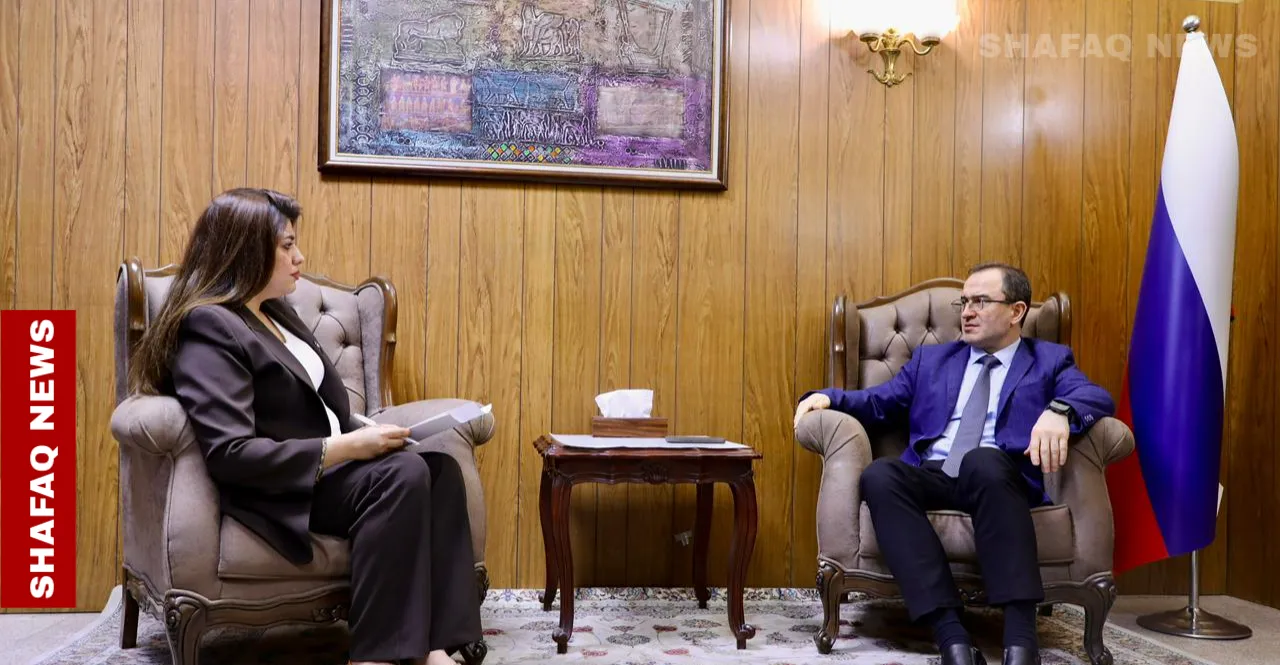
Amid sweeping geopolitical shifts across the Middle East, Russia’s envoy in Baghdad speaks with a calm but firm tone that blends confidence with pragmatism.
From a modest residence in the capital’s al-Mansour district, Ambassador Elbrus Kutrashev shared with Shafaq News his view of a region in transformation — and of Iraq’s delicate effort to balance between global powers without compromising its independence.
Behind the ambassador’s measured diplomacy lie clear messages about the complex web of Iraq’s relations with Washington and Tehran, the future of the Popular Mobilization Forces (PMF), the evolution of Iraq’s political system, the role of Kurdistan in Russia’s regional strategy, and Moscow’s renewed engagement in Syria.
Kutrashev described the partnership between Moscow and Baghdad as “steady and expanding,” covering the fields of economy, defense, energy, education, and culture.
He noted a “mutual desire among public and private institutions in both countries to advance cooperation through quiet, practical projects,” declining to elaborate further.
Although the planned summit between President Vladimir Putin and Prime Minister Mohammed Shia al-Sudani has been postponed, he said that “institutional mechanisms of cooperation remain active and function regularly.”
Between Washington and Tehran — Moscow Observes
The ambassador emphasized that Russia is not a player in Iraq’s balancing act between the United States and Iran.
“The confrontation between Washington and Tehran sometimes unfolds on Iraqi soil and at the expense of its stability,” he noted. “Moscow is not part of that contest.”
He voiced support for Baghdad’s strategy of diversifying partnerships and avoiding alignment with any single axis, adding that Iraq has faced “intense Western pressure since 2022 to sever ties with us over the Ukraine conflict — yet it stood firm and preserved its independent decision-making. That is a sign of political maturity.”
On the issue of armed factions, Kutrashev said Russia prefers neutrality: “These groups are an internal matter. No foreign state has the right to interfere. Russia takes an official position only when the Iraqi government formally requests it.”
He acknowledged that the PMF is part of Iraq’s state institutions, created under exceptional circumstances, describing the delay in legislating the PMF Authority Law “under external pressure” as regrettable. Moscow, he stressed, “rejects interference in the sovereign affairs of any nation.”
Kutrashev also offered a broader reflection on Iraq’s political system, describing it as “a product of extraordinary circumstances that cannot be judged by normal standards.”
“Russia experienced something similar,” he recalled. “We adopted our constitution after the 1993 crisis in Moscow when tanks shelled the parliament. We are still refining that system today.”
He added, “Iraq’s political order emerged under foreign occupation and severe insecurity, but it has evolved. Compared to twenty years ago, the situation is undeniably better.”
Weapons, Investment, and Energy Cooperation
In the defense field, the ambassador confirmed that Moscow continues its cooperation with Iraq “despite the US CAATSA sanctions law and related pressures.”
“Russia supplies Iraq with the defensive weapons it needs — unlike Washington, which imposes political restrictions on the type of armaments,” he remarked.
According to him, the obstacle is not financial, “but the foreign interventions that prevent Iraq from building a strong air-defense system.” He asserted that “Iraqis prefer Russian arms because they are more effective and cost-efficient.”
Kutrashev said Russian investment in Iraq has exceeded $20 billion, with new contracts expected in the coming months to boost oil output and improve energy efficiency.
“Cooperation goes beyond oil. It includes education, culture, energy, and infrastructure.”
Commenting on US objections to Iraq’s gas-transit projects with Kazakhstan and Iran, he argued that “such opposition reflects an American policy against Tehran that also harms Iraq.”
“The only legitimate sanctions are those issued by the UN Security Council,” he stressed. “Unilateral US measures are illegal. Iraq has every right to develop its economic relations with whomever it chooses.”
Kurdistan — From Mahabad to a 21st-Century Partnership
Recounting the roots of Russian-Kurdish relations, Kutrashev referred to the aftermath of the short-lived Republic of Mahabad in 1946, when Kurdish leader Mulla Mustafa Barzani and his fighters took refuge in the Soviet Union.
“We hosted more than 500 Kurdish fighters for a decade. Many studied in our schools and even married Russians before returning home,” he said, describing the episode as “a symbol of historic friendship between Russians and Kurds.”
Moscow, he explained, regards Kurdistan as an integral part of Iraq, and all Russian activities there are conducted with Baghdad’s consent.
At the same time, he acknowledged the Kurdistan Region as “an important economic partner and a gateway for regional cooperation.”
Russian projects in Iraqi Kurdistan are valued at around $2 billion, with potential for expansion. Kutrashev said Russia “welcomes the development and export of Kurdistan’s gas to Europe and does not see it as a threat to its own interests.”
The US Presence — Withdrawal or Redeployment?
On the continued US military presence in Iraq, the ambassador argued that “what is happening is not a full withdrawal but a redeployment.”
“Some forces and equipment are being relocated to Kurdistan,” he explained, “which does not signify the end of America’s presence in Iraq.”
He added that Washington “has no intention of relinquishing its influence in the Middle East. Its presence in Syria relies on bases in Iraq because there are no alternative logistical corridors.”
“Even if US forces leave the south,” he concluded, “they will remain in the north to maintain access to their installations in Syria and the Gulf.”
Read more:EXPLAINER: From the fight against ISIS to US withdrawal talks
Iraqis in the Ukraine War
Kutrashev addressed reports about Iraqis fighting alongside Russian forces in Ukraine, saying that media accounts of “hundreds or thousands” of such volunteers are “greatly exaggerated.”
“There are about 600,000 Russian soldiers on the front lines — this is a national war fought by our own people.”
He confirmed only a few isolated cases of Iraqis who joined the Russian army. One of them, he recalled, “visited our former military attaché on his return to Iraq to resolve personal matters and later expressed his intention to go back to the front.”
The embassy, he added, “issued visas for the relatives of two Iraqis who were killed in the conflict — these are the only officially handled cases.”
“At the beginning of the war, dozens of Iraqis asked to enlist, but we declined because no system allowed foreign recruitment at that time.”
“Later, a limited and complex mechanism was created requiring nomination by an accredited entity and approval by the Russian Ministry of Defense. Joining the army remains almost impossible for foreigners.”
Russia, he emphasized, “does not need foreign fighters; our military provides sufficient incentives for Russian volunteers — high salaries, compensation, and social benefits. If the door were open, thousands of Iraqis might have gone, but Russia relies on its citizens.”
In contrast, he said, Ukraine’s army includes large numbers of foreigners, including NATO officers and experts — “some have been killed or captured.”
“Russia Is Not the Soviet Union” and the “New Middle East” Vision
Kutrashev rejected comparisons between present-day Russia and the Soviet Union, particularly regarding ties with Iraq and the broader region.
“The world has changed drastically. China is now the leading economic power. Moscow is no longer alone facing Washington as in the 1970s,” he remarked.
“We may not have the same economic capacity as the Soviet Union, but we uphold the same principle — supporting Arab friends and partners without hidden agendas.”
The ambassador dismissed the notion of a “New Middle East” as “an American-made idea that has failed.”
“These unilateral projects do not reflect the interests of the region’s peoples but serve external powers,” he said, calling the outcomes of the so-called Arab Spring “disastrous.”
“One-third of Arab states are now trapped in crises or civil wars,” he noted. “We are not advocating the return of old regimes, but today’s reality is far worse than that of the former Middle East.”
Read more: The Desperate and the Damned: Why thousands of Iraqis are fighting in Ukraine
Syria After al-Assad — Between al-Sharaa and Moscow
Kutrashev addressed the political shift in Syria following the rise of transitional President Ahmad al-Sharaa, stressing that Moscow’s relationship with the new government “is not tied to Bashar al-Assad.”
He clarified that Al-Assad resides in Moscow “as a humanitarian refugee, not a political figure, and therefore cannot engage in any political or media activity.”
“Russia will not hand him over to any party — that would violate humanitarian norms,” he asserted.
Moscow, he added, explained to Damascus that pursuing Al-Assad’s extradition “would not serve its national interests, and the Syrian authorities accepted that view.”
Relations between the two capitals, according to him, are entering a new stage of economic and political cooperation.
“We supported Syria during its civil war,” Kutrashev concluded, “and we will continue to support it — economically and politically — in the name of stability and territorial unity.”