Riyadh, Damascus launch broad economic partnership after years of isolation


Shafaq News- Damascus
Saudi Arabia and Syria signed a sweeping package of strategic agreements on Saturday covering aviation, banking, digital infrastructure, water, transport, and real estate, marking one of the most significant economic re-engagements between the two countries since the lifting of sanctions.
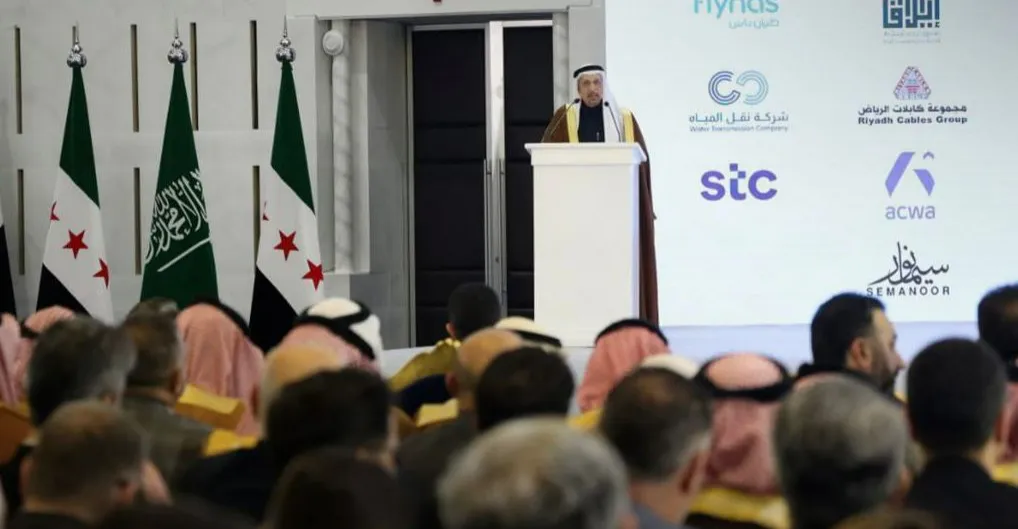
A high-level Saudi economic delegation arrived at the People’s Palace in Damascus, led by Investment Minister Khalid Al-Falih, to formally announce the deals in the presence of Syrian transitional President Ahmed Al-Sharaa. The agreements are framed as part of a long-term investment and development partnership rather than isolated commercial projects.
Speaking at the signing ceremony, Al-Falih said the Saudi delegation had formally launched the establishment of the Eilaf Saudi Fund, while also confirming the resumption of banking transfer channels between Saudi Arabia and Syria following the easing of international economic restrictions. “This presence in Damascus is an extension of a clear path toward building a shared future,” Al-Falih added, describing the accords as structural rather than symbolic.
Among the most prominent agreements was a joint aviation deal led by flynas, which Al-Falih said selected Syria as its first overseas investment destination. The package includes an agreement to develop and operate Aleppo International Airport, alongside the establishment of a low-cost national carrier under the name Flynas Syria. Officials noted that the planned airport would have a capacity of up to 12 million passengers annually, positioning Aleppo as a future regional transport hub.
Saudi and Syrian officials also signed what Al-Falih described as one of the largest digital infrastructure projects in the region, the Silk Link initiative, aimed at transforming Syria into a global data transit corridor. He further announced the signing of what he called “the world’s largest water agreement”, backed by ACWA Power, covering desalination and large-scale water transport.
Additional agreements included the forthcoming operation and modernization of the Syrian Modern Cable Company, as well as three real estate and infrastructure development contracts.
Syrian Communications Minister Abdul Salam Heikal said Syria’s telecommunications sector had suffered years of underinvestment, prompting the government to pivot toward projects that capitalize on the country’s geographic position.
Heikal pointed out that 18 companies applied to invest in the Silk Link project, with Saudi Telecom Company ultimately winning the bid after a technical evaluation. The project, he said, would position Syria as a digital bridge between Europe and Asia, reducing internet routing distances by 25–30% compared with existing pathways.
He added that the coming weeks would see the announcement of a new mobile phone license and the launch of Barq, a high-speed broadband initiative.
Joint technical efforts have also led to the resumption of Saudi freight transport between the two countries, officials remarked. The broader package concluded with the signing of a framework agreement for development cooperation, encompassing 45 development initiatives across multiple sectors.
Another memorandum of understanding with ACWA Power and Saudi Water Transmission Company outlines plans to build a seawater desalination plant and transport fresh water from Syria’s coast to southern regions, addressing long-term water security challenges.
Reacting to the announcements, US Special Envoy Tom Barrack praised the Saudi–Syrian investment agreements in a post on X, saying Washington welcomed initiatives that support reconstruction and regional stability. “Strategic partnerships in aviation, infrastructure, and telecommunications will contribute meaningfully to Syria's reconstruction efforts,” Barrack wrote, noting that “regional stability is best achieved when nations of the region take responsibility for their own future—and this partnership delivers on that principle.”
We commend the Saudi-Syrian investment agreements announced this week. Strategic partnerships in aviation, infrastructure, and telecommunications will contribute meaningfully to Syria's reconstruction efforts. As @POTUS has emphasized, regional stability is best achieved when…
— Ambassador Tom Barrack (@USAMBTurkiye) February 7, 2026